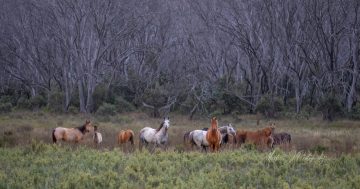
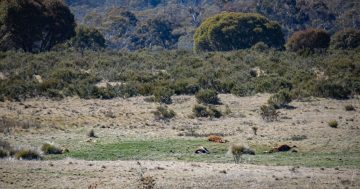
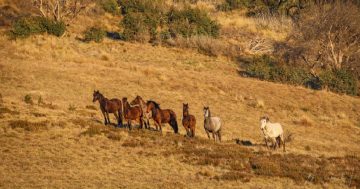
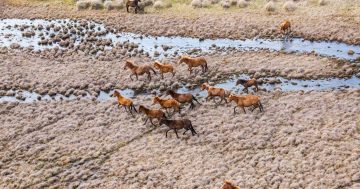
Wild horses in Kosciuszko National Park, where aerial culling and population estimates remain under intense scrutiny. Photo: NSW Environment & Heritage.
NSW Environment Minister Penny Sharpe has told a Budget Estimates hearing that wild horses shot from helicopters in Kosciuszko National Park (KNP) lose consciousness within five to eight seconds – less than half an hour after initially telling the same hearing the figure was 30 seconds.
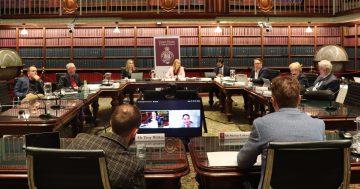
The correction came during a fiery hearing on Tuesday (18 August) that put the welfare of the aerial culling program under sustained scrutiny, as Upper House MPs questioned the minister and senior National Parks and Wildlife Service (NPWS) officials over the number of shots fired at horses, where those shots were placed and the reliability of population estimates being used to guide the cull.
Independent MLC Mark Latham told the committee he had “never seen such grief expressed by a vast number of horse lovers in NSW” and asked Ms Sharpe to end aerial shooting altogether.
Ms Sharpe rejected the call and defended the program as necessary to protect Kosciuszko’s alpine grasslands and waterways from damage caused by horses.
She said more than 7000 horses had been removed from the park in recent years, including about 1000 during the recent winter aerial operation in June and July, with the majority of removals carried out through aerial shooting.
Another 50 horses, she said, had been rehomed in the past month.
Questioned about the welfare of horses shot from helicopters, Ms Sharpe initially told the committee they, “become insentient and mostly dead within 30 seconds”.
She also defended the use of multiple rounds on individual animals, saying there was a misconception that aerial shooters were trying to kill each horse with a single shot.
“They use very high-grade weapons that often use multiple shots – seven, sometimes up to 15 – which guarantees that the horses die very quickly,” she said.
“It’s not one shot and then they’re harmed and wandering around and the helicopter has to come down and deal with it.”
Mr Latham questioned how the government could be certain of the timeframe when shots were being fired from a moving helicopter and raised concerns about the number of shots being fired.
Before the committee broke for its mid-morning adjournment, Ms Sharpe returned to her earlier evidence.
“I said that in relation to horses it was 30 seconds to insensibility,” she said. “It’s actually five to eight.”
The welfare debate resurfaced later in the hearing when Liberal MLC Rachel Merton questioned NPWS deputy secretary Alex Graham about the procedures governing aerial shooting.
Ms Merton told the committee that expert advice previously provided to the government had identified an accurate shot to the cranium, causing immediate unconsciousness and death, as the humane benchmark.
She contrasted that with what she said were the shot-placement directions contained in the NPWS H009 aerial shooting standard operating procedure (SOP), including shots to other parts of the body, and referred to trial data showing an average of 7.5 shots fired per horse.
Ms Graham did not dispute the figure and said the procedures had been developed, “under guidance and with the endorsement of veterinarians and the RSPCA”.
She said firing multiple rounds could represent the best welfare outcome because operators were required to continue shooting to ensure an animal died as quickly as possible.
Asked whether the SOP was publicly available as operational guidance, Ms Graham said it was not.
However, the H009 procedure is already on the public record. A copy was tabled during the NSW parliamentary inquiry into proposed aerial shooting of brumbies in December 2023 and remains publicly available among the inquiry documents.
Questions then turned to the deeply contested issue of how many wild horses remain in the park.
NPWS survey estimates put the population at between 2131 and 5639 in 2024, before rising to between 6476 and 16,411 in 2025, with a central estimate of about 10,000.
Asked whether NPWS remained confident in the data being used to guide aerial culling decisions, Ms Graham said she was.
“I am confident in the estimation of the population of wild horses in Kosciuszko National Park, as it is determined by the best survey method available internationally,” she said.
Ms Graham acknowledged there was, “a big difference” between the two surveys, saying the higher 2025 result was likely due to a combination of lower horse detectability during the 2024 survey and some population increase over the following year.
When Ms Merton said veterinarians and experts considered growth of that scale, “biologically impossible”, Ms Graham stressed NPWS was not attributing the entire increase to population growth.
“It’s also about the detectability of the horses in the 24 survey, which is why we believe that survey result was lower,” she said.
The disputed figures were also at the centre of questioning from Wagga Wagga-based Nationals MLC Wes Fang, who asked Ms Sharpe to suspend further aerial shooting until another count established whether horse numbers remained above the government’s target.
“I am aware that the method and the count is contested,” Ms Sharpe said.
Asked whether she would agree not to undertake further aerial culling until that had been established, she replied: “No, I won’t.”
Ms Sharpe said another horse count would be conducted later this year and indicated the methodology would remain broadly consistent so successive surveys could be compared, “apples with apples”.
The hearing also exposed a gap in public reporting on the park’s Wild Horse Community Advisory Panel, which brings together brumby advocates, conservation groups and NPWS staff.
Liberal MLC Jacqui Munro told the committee the panel’s minutes had not been published since December and asked Ms Graham whether it had met since.
“Yes, the panel has met since then,” Ms Graham said, but she was unable to say how many times or explain why the minutes had stopped appearing publicly, telling the committee she would come back with an answer.
She returned with a response in the hearing’s closing minutes, nearly five hours later, telling the committee the panel had met twice since December – once in March and once in June – with minutes from both meetings still awaiting publication.
“We are a bit delayed in publishing both those minutes,” Ms Graham said, “but we will make that a priority this month.”
Mr Fang also asked how much the government had spent on aerial brumby control since Labor came to office.
Ms Sharpe did not have the figure available and took the question on notice.
The government is working towards a legally required target of 3000 wild horses in designated retention areas by 30 June 2027.
NPWS has also flagged aerial feral animal control operations in selected parts of KNP throughout November, with closures scheduled from 2 to 27 November.
The public notice does not specify that horses will be the sole target.
Original Article published by Edwina Mason on About Regional.