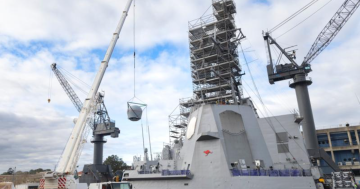

Lockheed Martin Australia’s winning JP9102 SATCOM tender was cancelled in 2024. Image: Lockheed Martin.
The Australian Defence Force (ADF) has released a new tender for a sovereign narrow-band UHF Satellite Communications (SATCOM) capability.
The request for tender (RFT) comes 15 months after a request for information (RFI) for the Space (SPA)9102 SATCOM requirement was released to industry, and less than two years after Defence Minister Richard Marles cancelled a similar but larger-scale project in November 2024.
Previously designated Joint Project (JP)9102, a team led by Lockheed Martin Australia was announced in April 2023 as the preferred tenderer to provide an Australian-owned and operated geostationary earth orbit (GEO) SATCOM system.
Lockheed Martin’s team included Australian companies Inovor Technologies, EM Solutions, AV-Comm, Linfox, Shoal Group, Ronson Gears, Calytrix Technologies, Conscia, Clearbox Systems, DXC and Blacktree Technology.
The winning tender was selected ahead of bids headed up by Boeing Defence Australia, Northrop Grumman Australia, Airbus Australia Pacific, and Optus.
The original JP9102 system was to have comprised between three and five Defence-controlled and operated geostationary communications satellites, multiple ground stations across Australia, an integrated SATCOM Management System, and two new satellite communications operations centres.
But in November 2024, Mr Marles announcement the project’s cancellation due to an “acceleration in space technologies and evolving threats in space since the project’s commencement”.
He said, “Defence has assessed that a single orbit GEO-based satellite communications system would not meet strategic priorities”, and that “Defence has decided to cease its current procurement activity with Lockheed Martin Australia for a single orbit GEO-based satellite communications system.”
The new SPA9102 tender released in early September is substantially scaled back from that of JP9102, with a requirement for just a single narrow-band UHF satellite to be placed in geostationary orbit rather than the previously planned network of at least three satellites.
A follow-on phase of the project is expected to be released in the future which will cover a wideband SATCOM capability.
The ADF currently uses space on the US’s Wideband Global Satellite (WGS) network which it also shares with Canada. By funding the sixth of the 10 satellites in the WGS constellation, Australia was able to gain limited network access across the constellation.
The ADF also has a small narrow band UHF SATCOM payload aboard the Optus C1 satellite which was as launched in 2003 and has already been extended well past its planned 15-year service life.
Tender responses are due to be submitted to Defence by December, with the tender documents saying a down select of the winning tender is currently scheduled to be made in the second quarter of 2027.
A 15 September report in The Australian said the ADF’s Head of Air Defence and Space Systems, Air Vice Marshal Martin Nussio told the Joint Capabilities Group Space and Cyber Industry Forum in July that the RFT covers the spacecraft, its launch, autocorrection, and its introduction to service.
The Australian also quoted a Defence spokeswoman as saying the ADF requires, “a resilient, multi-orbit satellite communications capability, optimised for operations and enhanced communications in the Indo-Pacific in a way that reflects advances in technology and grows opportunities for the sovereign Australian defence industry over time”.
“Defence is delivering this capability through multiple elements under Project SPACE 9102,” she said.
“In the contemporary space operating environment, all orbital regimes remain at risk and the proposed narrowband geostationary satellite represents one part of a broader resilient architecture that Defence is pursuing through SPACE 9102.”
As with the previous tender, it is expected Lockheed Martin, Northrop Grumman, Boeing, Airbus and Optus are expected to pitch for SPA9102.
Opposition Defence spokesman Senator James Paterson told ABC Radio National Breakfast on 16 September that the new tender came after what he described as “an extraordinary mess of Richard Marles’ making”.
“When the Albanese Government came to power, they inherited a tender to acquire a sovereign geostationary single large military communications satellite,” he said.
“They cancelled that because Richard Marles said very memorably it could get blown out of the sky. And it looked like they were going to prefer what’s called a MEO or LEO constellation of mid-Earth or low-Earth observation satellites [instead of geostationary] that were distributed and therefore less exposed to that risk.
“Well, they’ve now cancelled that process too and they’ve gone back to square one and they’re now seeking again a single large geostationary satellite which would be as vulnerable now as Richard Marles says it was four years ago,” he added.
“And what have we lost in the meantime? We’ve lost that time and it’s so critical in a dangerous world that we have these sovereign capabilities. The waste of money is one thing, but the waste of time is extraordinary.”