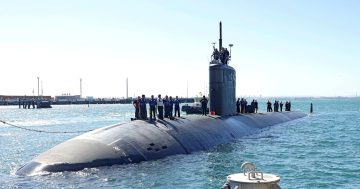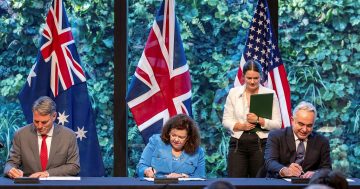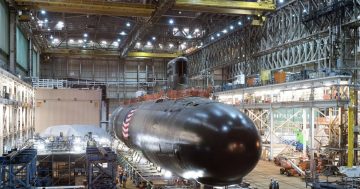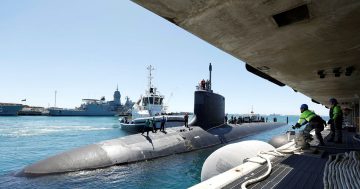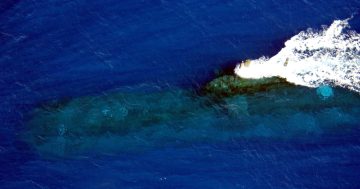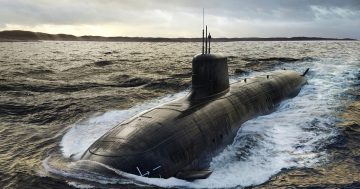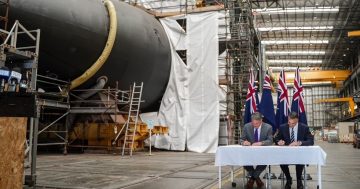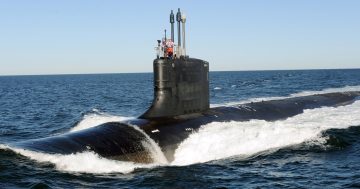

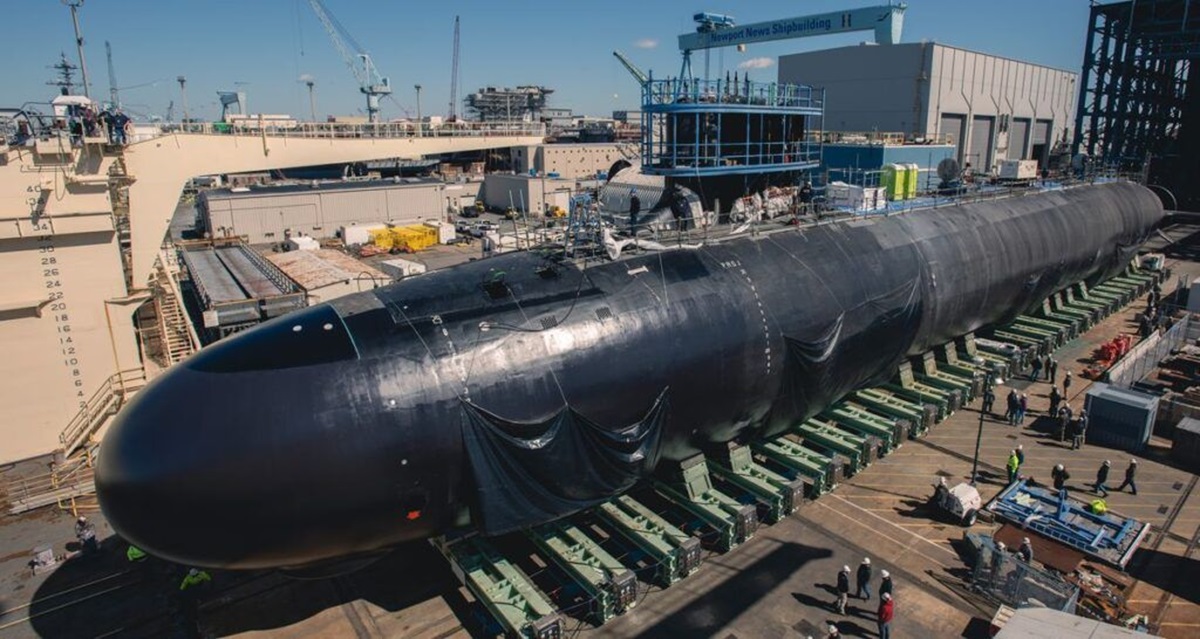
US Navy Virginia-class SSN production continues to languish at a rate of less than 1.3 boats per year, well short of the 2.33 per year rate required. Photo: HII.
The prospects of Australia operating former US Navy Virginia-class nuclear powered attack submarines (SSN) from 2032 appear to be as remote as ever, with the US industrial base still unable to build boats fast enough.
A US Congressional Research Service (CRS) report released on 26 January shows that, despite injections of resources and Australian cash into the US submarine construction industrial base, the build rate of Virginia-class boats continues to lag.
Under the multi-phased Pillar 1 of AUKUS, Australia has been embedding Royal Australian Navy and defence industry personnel with the UK Royal Navy and US Navy uniformed maintenance and industrial base to accelerate their training.
At the same time, the frequency of US and UK SSN port visits has been ramping up in the lead-up to deployments of longer duration by one UK and four US SSNs to HMAS Stirling in WA under the planned Submarine Rotational Force-West (SRF-West).
Also under Pillar 1, Australia is to buy two used and up to three new Virginia-class SSNs from the US Navy from FY2032 to FY2040.
Under what the Commonwealth has dubbed the “optimal pathway”, the Virginia boats will bridge a gap between the current and rapidly aging Collins-class conventional boats, and a new class of SSN AUKUS boats that are to be jointly developed by all three nations, and serve with the UK and Australia.
In an effort to increase SSN production capacity, Australia last year paid a US$3bn (A$4.21bn) contribution to the US submarine construction industrial base. On top of that, Australia is also investing an additional $4 billion in its own industrial base so it can build and sustain SSN AUKUS boats in Adelaide and WA.
The report says the US Navy’s fleet of SSNs is barely half what it says it requires. Of the 47 Virginia, Seawolf, and remaining Los Angeles-class boats in service in FY2024, 16 – or more than a third of the fleet – were unavailable due to being in maintenance. The US Navy says it requires an SSN fleet of 66 boats.
All US nuclear-powered submarines – both the Virginia-class SSN and the new Columbia class nuclear missile boats (SSBN) – are built at just two shipyards, General Dynamics’ Electric Boat Division in Connecticut, and Huntington Ingalls Industries’ Newport News Shipbuilding in Virginia.
The CRS report says the submarine construction industrial base includes about 16,000 suppliers in all 50 US states, about 70 per cent of which are sole-source suppliers.
From 2011 to 2024, the Pentagon ordered Virginia-class SSNs at a rate of two boats per year, although the actual production rate never reached two per year. In fact, the report says that since 2019, shipyard and supplier firm workforce and supply chain challenges saw production slow down to a low of just 1.13 boats per year in 2024.
The CRS says the US Navy’s (and Australia’s) investments to strengthen the industrial base saw a steady increase in the hiring at these shipbuilders in 2023 and 2024, while the capacity of supply chain vendors also increased.
But despite this, the report says the required production ramp-up of both the Virginia and Columbia-class boats has not occurred, and continues to languish below 1.3 boats per year, well short of the 2.33 rate it needs to be at to replace the remaining Los Angeles class boats, to get to its required fleet of 66 SSNs, and to be able to release submarines for Australia under the optimal pathway from 2032.
“Starting in FY2018, Congress has appropriated billions of dollars of submarine industrial-base (SIB) funding to support this effort,” it reads.
“Although Virginia-class boats have been procured at a rate of two boats per year, the actual Virginia-class production rate has never reached 2.0 boats per year, and since 2022 has been limited by shipyard and supplier firm workforce and supply chain challenges to about 1.1 to 1.2 boats per year, resulting in a growing backlog of boats procured but not yet built.
“How quickly this effort will succeed in increasing the Virginia-class production rate to 2.0 boats, and subsequently to 2.33 boats per year, is not clear.”
Despite the increasing uncertainly, outgoing Australian Submarine Agency head VADM Jonathan Mead has repeatedly said that there is no Plan B or C if the optimal pathway comes to a dead end, and has instead described it as a, “no fail mission”.
But the CRS has floated an option that might instead see the Virginias “retained in US Navy service and operated out of Australia”.
“Selling three to five Virginia-class SSNs to Australia would thus convert those SSNs from boats that would be available for use in a US-China crisis or conflict, into boats that might not be available for use in a US-China crisis or conflict,” it says.
“This could weaken rather than strengthen deterrence and warfighting capability in connection with a US-China crisis or conflict.”
Instead of buying the Virginia boats, the CRS report suggests Australia could instead “invest those funds in other military capabilities … [including] long-range anti-ship missiles, drones, loitering munitions, B-21 long-range bombers … or other systems so as to create an Australian capacity for performing other missions, including non-SSN military missions for both Australia and the United States.”