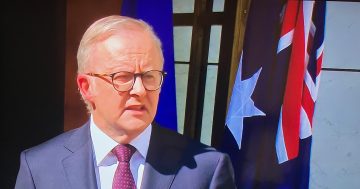


Prime Minister Anthony Albanese made the right decision in calling a royal commission into the Bondi attack, even if it took him some time to do so. Photo: Thomas Lucraft.
Amid all the demands for Anthony Albanese to call a royal commission following December’s horrific terrorist attack on Bondi Beach, there was also quite a bit of commentary as to why the Prime Minister shouldn’t.
Some solid arguments were put up against establishing a royal commission into the shootings and the rise of antisemitism in Australia.
The counterpoints were mostly all sound, with some saying it would be a waste of money and pointing to the (non) accountability factor resulting from numerous royal commissions.
A few non-mainstream commentators, however, talked in terms of witch hunts and some of the more tasteless referenced their own antisemitism by suggesting the Jewish community in Australia already has too much influence.
Here’s my counterpoint to those counterpoints: If ever there was a case for a royal commission, this is it.
The deliberate and calculated gunning down of 15 people celebrating Hanukkah on an iconic Australian beach is the worst terror attack in this nation’s history and the second deadliest mass shooting in Australia’s modern history.
A royal commission is the highest form of independent inquiry on matters of public importance this country has, and the Bondi victims deserve no less.
Royal commissions are only established in rare and exceptional circumstances and to not hold one over the circumstances that led to this terror attack would suggest it wasn’t such an exceptional event.
But it was exceptional and disturbingly so.
The Royal Commission on Antisemitism and Social Cohesion, finally called and established last week, isn’t so much an inquiry about corruption (which is the focus of some commissions), as one of – among other things – failures in policies and procedures, laws and regulations, attitudes and perceptions.
And despite the arguments to the contrary, royal commissions absolutely have an impact.
On a purely procedural and public sector level, they change how things happen.
Recommendations adopted from royal commissions change how public servants are trained, how policies are developed and how regulations are enforced.
They change culture; they demand more legal checks as a matter of course when developing policy; they require greater data governance; better record-keeping; more checks and balances; higher levels of accountability.
Sure, not all recommendations are always adopted from many (most?) royal commissions – but there are always enough embraced to see these institutional changes take place. Always.
Aged care in this country is still by no means perfect, but it is in far better shape since the Royal Commission into Aged Care Quality and Safety and its 148 recommendations in 2021.
The Royal Commission into Institutional Responses to Child Sexual Abuse resulted in the establishment of the National Redress Scheme to provide compensation for victim-survivors.
That scheme’s rollout is a mess, to say the least. But there was nothing for victims before. Not even acknowledgement.
Numerous other schemes have been put in place as a result of that royal commission. Ones that involve the present and look to the future, including the mandating of reporting of certain behaviours in institutional care settings.
There are now reportable conduct schemes in all jurisdictions because of that one royal commission.
The Federal Government has accepted the majority of the 122 recommendations of the Royal Commission into Defence and Veteran Suicide and has embarked on a program of reforms to improve outcomes for serving and ex-serving personnel.
We’d all like to see some heads roll over the illegal Robodebt scheme and we might have a long wait yet.
Commonwealth royal commissions resulting in trials of politicians and public servants is a far rarer occurrence than those of state-based ones.
But the Royal Commission into the Robodebt Scheme has left no doubt as to who was responsible for breaking the law, who ignored legal advice, who couldn’t care less for Australia’s most vulnerable, who only looked after their own backs and careers, and who lied under oath.
Automated decisions over debt collecting must now have an actual human make the final call. That’s because of the Robodebt royal commission.
The list goes on. Royal commissions are not legally binding, but they inspire change and they set in stone records of what went wrong and what must change.
They cost a lot, that’s true. But that’s how government works, and to suggest the money should be instead funnelled to other resources exposes a naivety over the political system.
The long list of celebrity calls for a royal commission over Bondi looked contrived and calculated and bordering on disingenuous.
Former High Court chief justice Robert French’s call for one was not, however, and neither were the pleas from the Jewish community.
Opposition Leader Sussan Ley was right to persist in her demands for a Commonwealth royal commission to be established.
Mr Albanese was right to call one, albeit coming late to the party.
There will be pain for the Federal Government in this inquiry.
Royal commissions are fiercely independent – and Bondi happened on Labor’s watch after many calls for it to do more about the rise in antisemitism in Australia.
But the right decision has been made.
The Bondi attack and the circumstances that allowed it to occur warrant the highest level of scrutiny the political system can give.
Original Article published by Chris Johnson on Region Canberra.