

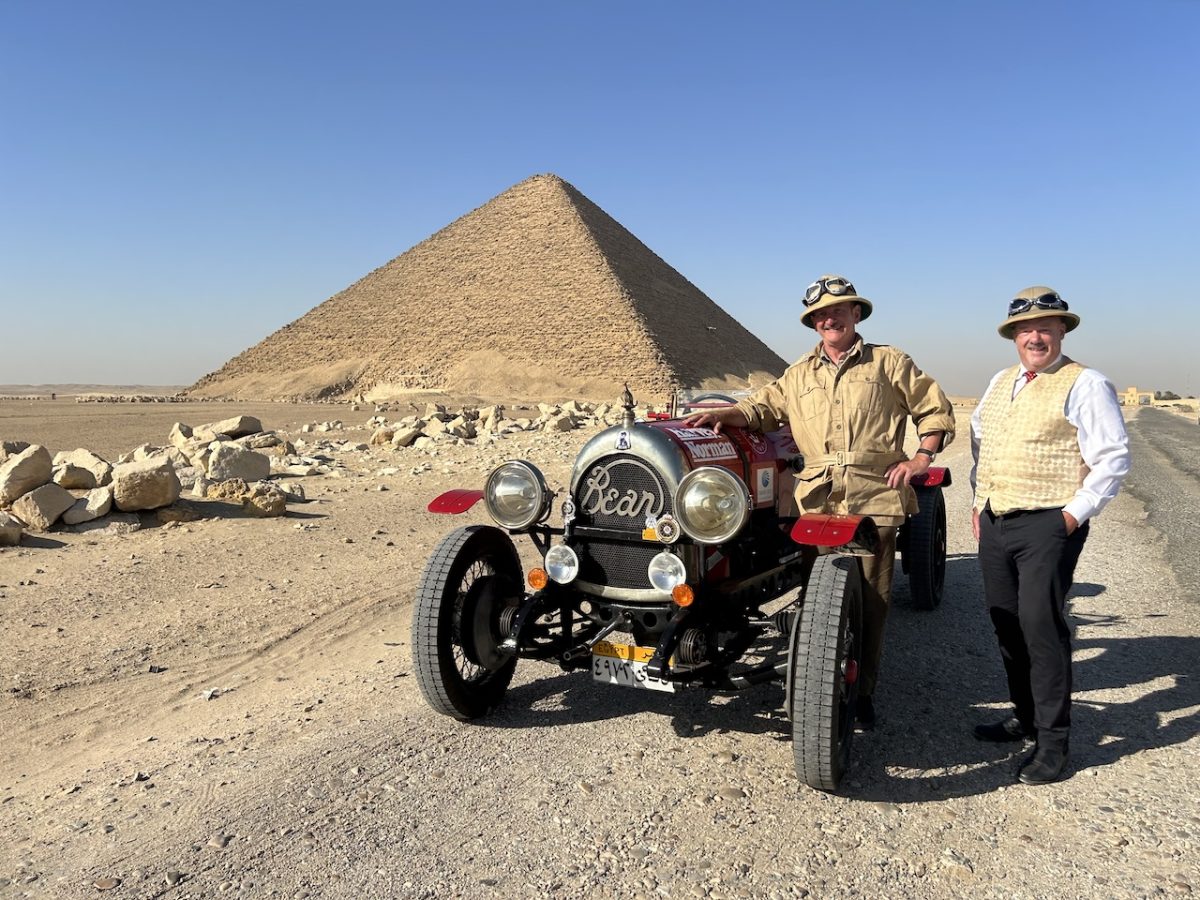
Australian author, cartoonist and adventurer Warren Brown (left) with friend Matthew Benns near the Red Pyramid, the third biggest in Egypt. Photo: Supplied.
James Mason gets into the festive spirit with a light-hearted look at project management during the building of the pyramids compared with what we have today.
When most people think of pyramid builders, they imagine slaves whipped under the desert sun or aliens landing with laser beams. The truth is more down-to-earth.
Ancient Egyptians lived on beer. Workers who built the pyramids were rationed around four litres a day. Beer wasn’t a luxury; it was hydration, payment, and fuel.
In fact, beer and bread were the backbone of the pharaohs’ entire workforce economy.
So yes, one of the Seven Wonders of the World was constructed by what can only be described as a civilisation of boozers.
The pyramid builders weren’t being reckless. Beer in ancient Egypt was safer than Nile water (which was riddled with parasites).
It was thick, nutritious, and packed with calories — imagine a cross between a smoothie and a schooner of bitter.
It also doubled as a salary. Workers were sometimes paid in beer, and their daily ration became a form of currency.
Today, we get an awkward email about “employee engagement initiatives”. They got four litres of beer. Honestly, who had the better deal?
The Egyptians didn’t just drink beer; they mastered it. Beer was brewed from barley and emmer wheat, often with dates added for flavour.
It had a cloudy, porridge-like texture. Forget crisp lager, think ‘’liquid bread’’. It was brewed in massive vats, making it one of the first large-scale industrial processes in human history.
In essence, the Egyptian brewery was the ancient world’s HR department. Without beer, morale collapsed, productivity fell, and complaints probably doubled.
If today’s HR existed back then, pyramid-building would never have got off the ground. Picture the memos:
“Reminder: All workers must complete their Alcohol Awareness E-Learning Module by Friday.”
“Beer rations will now be capped at two litres to reduce productivity risks.”
“Pyramid Project suspended pending further consultation with the Health and Safety team.”
Meanwhile, 4500 years later, we still can’t fix the office printer.
Let’s compare workplace perks, then and now:
Egyptians: Beer, bread, meat on feast days, job security tied to divine purpose.
Australia: Instant coffee, a free pen on induction day, and maybe a pizza voucher if your boss is in a good mood.
It’s no wonder their monuments still stand, while your office Wi-Fi drops out during every Teams call.
Think about what the Egyptians achieved while drinking beer daily: They invented a writing system that still fascinates linguists; they engineered pyramids that align with the stars; they built structures visible from space.
Now think about what the average modern office achieves in a week: Countless unread emails; pointless Teams calls; a broken vending machine.
Maybe, just maybe, a lunchtime schooner would improve things.
Some cultures do embrace workplace drinking. In Japan, ‘’nomikai’’ after-work drinks are part of corporate bonding; in parts of Europe, beer or wine at lunch is culturally accepted; start-ups in Silicon Valley proudly boast of beer fridges in the office.
Meanwhile, in your office, if you so much as sniff a shandy, HR has a field day.
We often joke that today’s employees are lazy, distracted, or unproductive, but let’s face it, Egyptian workers had it worse.
They worked in 45-degree heat, hauled multi-tonne stones, and still managed to clock out with enough energy to enjoy their evening litre.
Contrast that with the modern worker, who declares burnout after formatting one Excel spreadsheet. Maybe the Egyptians had it right: Keep everyone watered (with beer) and morale sorts itself out.
The pyramids are still standing 4500 years later. Your office chair barely lasts six months before collapsing. Maybe there’s something to be said for Egypt’s beer-fuelled approach to labour.
So, the question remains: If the Egyptians could build wonders of the world while drinking beer daily, why can’t you have a schooner at lunch without HR knocking on your door?
Seriously, though — as pyramid-building is unlikely to be your organisation’s core business, take it easy during the festive party season.
*James Mason has worked for various organisations over an 18-year career. A seasoned blogger, he has created the blogsite Office Bantomime. This article first appeared on the Office Bantomime website.