Realism: In Challenging Anzac: Stories that don’t fit the legend, leading Australian historians examine how the reality of warfare has always been at odds with mythic representation, and consider why, despite this, the Anzac legend has survived. Photo: Supplied.
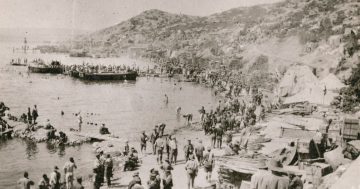
Australians gather in silence at dawn every year on 25 April to honour soldiers who died in a failed campaign fought on distant shores in 1915.
The Anzac legend — whose influence on Australians is long-standing — has shaped Australia’s national identity for more than a century. Yet many experiences of war do not fit comfortably within such a social construct.
In Challenging Anzac: Stories that don’t fit the legend, award-winning Australian historians Mia Martin Hobbs, Carolyn Holbrook and Joan Beaumont examine how the reality of warfare has always been at odds with mythic representation and consider why, despite this, the Anzac legend has survived.
The editors explore some of these stories: Aboriginal activists, deserters on the Western Front, veterans who took their own lives and soldiers who became radicalised by their service. They reveal how episodes in Australia’s war history that unsettled the Anzac legend — from the relief of Tobruk and nuclear testing on Australian soil to feminist protests against war and alleged atrocities in Afghanistan — have been elided or adapted to ‘’fit’’ the legend.
Hobbs is an oral historian at Deakin University, Holbrook is also a historian at Deakin University, and Beaumont is recognised for her work in Australian history.
In the first chapter, titled Challenging Anzac: Why now?, observations are made about certain invocations of Anzac being “… as common as they are banal and vapid. While the word ‘Anzac’ remains code for a unifying nationalism, ‘Australian values’ and support for the projection of military force overseas, it conveys little of substance on matters of war or military service.”
The editors continue to assert their views: “The ubiquity of ‘Anzac’ requires us to explain how we understand this remarkable acronym, known variously as the Anzac myth, or legend, or simply by the shorthand term of Anzac.
“From its origins, Anzac was a celebration of the Australian soldiers of the First World War. The official historian, Charles Bean, and other early exponents of the Anzac legend believed that volunteers, although civilians, had proved to be exceptional fighters. Their prowess could be explained only with references to the society from which they came. This was, Bean claimed, an unusually classless and egalitarian society, where the ethos of the bush infused even urban life. Australian soldiers were resourceful, disrespectful of authority, prone to self-deprecation, quick with laconic humour, courageous, able to endure hardship and, above all, willing to risk their lives for the sake of their mates.”
An absorbing anthology, Challenging Anzac expertly explores various stories that deviate from the spirit of Anzac.
Narrative of the Anzac soldier was always part-myth. “… Commemorated originally as a day of mourning the dead, community pride and encouragement of others to enlist. Anzac Day and its rituals became a key element in ‘the symbolic repertoire available to the nation-state for binding its citizens into a collective national identity’.
“In the century and more since the Australian and New Zealand Army Corps was created in early 1915, this acronym of ‘Anzac’ has come to acquire multiple meanings. Though Anzac Day came under attack in the post-1945 years, and was expected to wither and die as the veterans of the two world wars died, it survived and resurged during the national memory ‘boom’ from the 1980s on. Gradually, the term ‘Anzac’ morphed to be a generic signifier of national identity, or simply ‘what it means to be Australian’.”
The events at Gallipoli have, gradually, come to seem more than a military memory. They have transformed into a national myth that claims to show the character of the Australian people to many observers. While it began in loss, and the Anzac legend has influenced how Australians speak about courage and sacrifice as part of Australian identity, it continues to influence national life in clear ways.
As it must, their study of challenges to Anzac concludes with the issue of the Anzac legend’s status today, and in the future. While these stories do not readily “fit” the Anzac legend, it is highly unlikely to lose its central place in Australian political culture and society.
“… the power of Anzac’s group-binding rituals helps us to understand its abiding presence across the generations as a primary signifier of Australian characteristics and values. A more psychologically informed explanation of the nature of Anzac helps us understand why, despite over a century of challenges, the legend endures.”
Challenging Anzac: Stories that don’t fit the legend, edited by Mia Martin Hobbs, Carolyn Holbrook and Joan Beaumont, NewSouth, $39.99