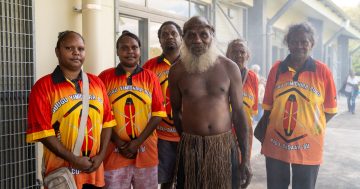
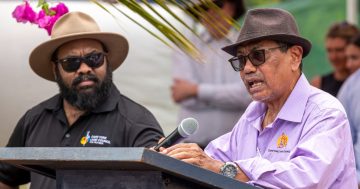
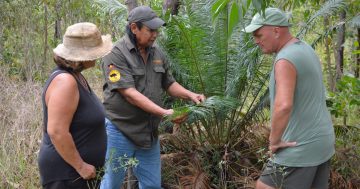
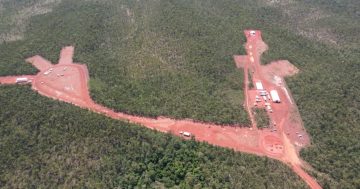
The Eastern Kuku Yalanji native title determination. Photos: Cape York Land Council/Maxwell Media.
Cape York’s largest group of traditional owners are celebrating a historic native title rights determination over almost 218,000 hectares of land on the southeast of the peninsula – an area larger than many small countries.
The Federal Court has recognised the Eastern Kuku Yalanji’s claim for the 217,884 hectares and a separate native title determination for the Western Yalanji people is due to be delivered on Friday (14 August).
Hundreds gathered at Wujal Wujal Sports Oval in the Aboriginal community about 350 km north-east of Cairns on Wednesday (12 August) to observe the milestone for the Eastern Kuku Yalanji people.
The determination covers land from the Annan River in the north to the Daintree River in the south, east of the Great Dividing Range. It includes Cape Tribulation, Black Mountain, Thornton Beach, Cow Bay, and Wujal Wujal.
It also covers parts of the Annan, Bloomfield, Daintree, East Normanby, West Normanby and Granite Normanby river systems, and areas in the Daintree National Park (CYPAL), Annan River (Yuku Baja-Muliku) National Park, , Kalkajaka National Park (CYPAL), Ngalba Bulal National Park (CYPAL) and Mount Windsor National Park.
Cape York Land Council acting CEO Richie Ah Mat said the day belonged to those who began seeking recognition decades ago.
“The elders wanted the generations coming behind them to have their rights recognised, to be back on country and to have the opportunity to build an economic future in their place,” he said.
Eastern Kuku Yalanji elder William ‘Billy’ Harrigan said: “Our grandparents and parents began this and now we are finishing it.”
“We are so proud of this,” Mr Harrigan said.
“The wisdom of our elders who have passed will be carried on forever.”
Elder Francis Walker said the determination honoured previous work and opened a new chapter: “Native title means the hard labour of our people and our journey throughout is finally complete.”

Eastern Kuku Yalanji elder Frances Walker.
The determination is the 33rd of its kind under the Cape York United #1 Claim, which is a major regional push to resolve native title claims.
The decision recognises “a mix of exclusive and non-exclusive native title rights and interests, with exclusive native title applying across approximately 35 per cent of the area”, according to the Cape York Land Council (CYLC).
“At the meeting point of the Wet Tropics and Great Barrier Reef World Heritage areas, the determination covers country where internationally recognised rainforest and reef values form part of the living cultural landscape of Eastern Kuku Yalanji people,” a statement reads.
“But for Eastern Kuku Yalanji people, today is the realisation of their elders’ vision and persistence, that their people would have their rights recognised, protect their culture and country, build strong institutions, and have a genuine say in decisions about their future.”

The crowd at the Eastern Kuku Yalanji native title determination.
The CYLC said more than 100 ancestral lines united in the celebration.
Notable attendees included Cape York Land Council co-founder and traditional owner Noel Pearson, elder Chrissy Grant AM, Jabalbina Yalanji Aboriginal Corporation chair Laurel Denman, the Eastern Kuku Yalanji and Jabalbina’s Trinity and Kallum Clarke, and elder Desmond Tayley.
Eastern Kuku Yalanji elder Carol Pierce said native title would strengthen the connection between young people, culture and bubu (Country).
“Native Title means that our people can go back on Country, live on Country and continue to teach our younger generations how important our Country and culture are,” she said.

The Eastern Kuku Yalanji native title determination marked the culmination of decades of work.
Elder Kathleen Walker said the determination was for everyone in the community, those who had gone before and those still to come.
“I remember the people before me and the people who come after me,” she said.
“This is for everyone and so that our stories are never forgotten.”
Emerging elder Karen Shuan said the recognition was a milestone and gave the next generation practical opportunities.
“It means everything to me. It’s been a long journey for our people to get to now,” she said.
“We will stay connected to our bubu forever and now we can have more job opportunities to keep looking after our land. This will help our future generations too.”
Another emerging elder, Pamela Salt, said the decision was a legal recognition of the truth.

The Eastern Kuku Yalanji native title determination.
“It identifies us, in white man law, that this is our bubu and it always has been,” she said.
Jabalbina, the prescribed body corporate for the Eastern Kuku Yalanji people’s 2007 native title determination, has been nominated to take up responsibilities.
One of the organisation’s rangers, Michael Yeatman said: “Native title means safeguarding our bubu and culture for the younger generation.
“It acknowledges the efforts of our old people and gives our young people a future.”
CYLC chair Clara Day said the determination marked the beginning of something bigger.
“Jabalbina is achieving great things already. With its people, knowledge and big plans for the future, Eastern Kuku Yalanji country is in good hands,” she said.
The CYLC detailed how the determination came to be and said that in 1978, Lutheran pastors were on a committee established to investigate the concerns of the people of Hope Vale and Wujal Wujal. They found locals were “deeply hurt” about being pushed from their traditional lands and “herded into camps” due to “the encroachment of white settlers”.
The Eastern Kuku Yalanji people lodged their first native title claim through the Cape York Land Council in December 1994, soon after Mabo created a legal pathway for Aboriginal and Torres Strait Islander peoples to seek native title recognition.
Wujal Wujal land rights pioneer Adelaide Baird was at Lockhart River in 1990 when the council was established and she supported the vision for Indigenous people on the Cape to lead the fight.
The CYLC said Ms Baird rallied the community behind Mr Pearson and the council at the time and spurred family leaders “to take forward that first claim and ongoing campaigns for rights” and stick to their recognition vision “through the decades of meetings, research, evidence gathering and legal work”.
The determination involved the support of various organisations, including Cook, Douglas and Wujal Wujal Aboriginal shire councils.
Original Article published by Luke Mortimer on Cape York Weekly.