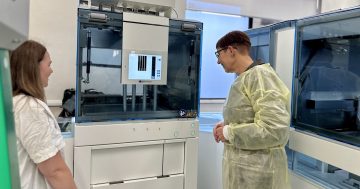
Health Minister Rachel Stephen-Smith tries out the new Optos Silverstone RGB laser eye scanner. The Canberra Hospital is the first in Australia to receive and use the system. Photo: Michelle Kroll.
A new piece of eye-catching tech at the Canberra Hospital cost $264,000, but it is already changing lives.
In an Australian hospital first, the Optos Silverstone RGB Ultra-Wide Field Imaging Device was installed at the Canberra Hospital Eye Clinic in January.
The state-of-the-art machine is providing faster, clearer and more accurate images of the eye, in particular the back of the eye, for the 1200 patients from across the Canberra region who attend the clinic every month.
That means better diagnoses, not just for what clinicians expect to find, but also uncovering conditions that might have remained hidden before or take longer to become apparent.
Clinic Coordinator Barb O’Brien said the new device had already paid for itself with the results it was providing and better patient outcomes.
Ms O’Brien said one patient had been referred for a particular issue, but by scanning both eyes, clinicians detected an unknown retinal detachment.
That would have meant quicker access to sight-saving surgery if that was required, she said
“We would have had to do a whole lot more imaging, and it wouldn’t have been something that we would have just seen easily,” Ms O’Brien said.
“It was really gratifying to see something unexpectedly.”

Ophthalmologist Dr Jane Wells examines images of the minister’s eye.
The key features of the Optos are its wide field of view and its broader colour spectrum, which capture highly detailed, more true-to-life images of the eye.
Previous laser scanning machines only covered about 30 degrees, but the Optos provides a comprehensive 200‑degree view of the retina that previously required multiple photos.
Ophthalmologist Dr Jane Wells said this extra capacity made a world of difference to patients with problems at the back of the eye.
Dr Wells said the Optos also enabled angiography to study the blood vessels and blood flow at the back of the eye, which could be important for detecting diseases like diabetic retinopathy.
Clinicians could also perform dedicated scans of the retina and see almost down to a cellular level.
Dr Wells said the earlier laser scanning machines used only red and green channels, but the Optos also had a blue channel, which provided a much truer colour of the back of the eye and helped earlier diagnosis in some conditions.
“This will become the gold standard for looking at conditions at the back of the eye,” she said.
Dr Wells said the main condition the clinic dealt with was diabetes, which could lead to blindness, as well as macular degeneration and inflammatory conditions affecting the eye and its blood vessels.
“We can also take photographs of the optic nerve, which is the cable that leads from the eye to the brain, and that becomes affected in glaucoma,” she said.
“So we can monitor all of those conditions a lot more accurately.”
The Optos also meant a smoother experience for patients, especially children and those in wheelchairs. In some instances, dilating drops were no longer needed, allowing patients to drive immediately after a consultation.
Health Minister Rachel Stephen-Smith said the Australia-first acquisition was a credit to hospital clinicians and support staff who monitored the market and worked closely with suppliers like Optos to ensure Canberra Health Services had timely access to the latest technology.
“It’s a demonstration across Canberra Health Services that we work really hard to ensure that we’re procuring the best for the Canberra community,” she said.
Original Article published by Ian Bushnell on Region Canberra.