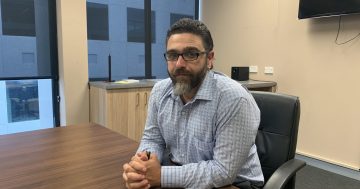
Secretary Alex Caruana says the AFPA has been raising concerns about safety and welfare concerns for former undercover officers since 2021. Photo: James Day.
The Australian Federal Police Association (AFPA) has called on the Federal Government to provide resources for the ongoing protection of former AFP undercover officers and their families.
In a 24 August release, the AFPA said longstanding and unresolved safety and welfare concerns going back to 2021 remained for the former officers and their families.
It said it had been involved in the matter for several years, and remained concerned that fundamental questions about their safety had not been satisfactorily resolved.
AFPA president Alex Caruana said the undercover members had performed some of the most sensitive and dangerous work undertaken on behalf of the Commonwealth.
“They operated against serious organised crime and other high-risk targets, assumed identities, developed relationships with dangerous individuals, and accepted extraordinary personal risks in the national interest,” he said.
“The operational deployment may finish, but the risks created by that work do not necessarily finish with it.
“If Australia asks police officers to accept extraordinary risks on behalf of the community, the Australian Government has an obligation to stand behind them when the consequences of that service continue for years afterwards,” he added.
The AFPA says, in May 2022 it took formal action under the Work Health and Safety Act 2011 to examine whether appropriate measures were being taken to protect affected members.
Since then, it has pursued the matter through meetings with senior AFP executives, threat and risk assessment processes, professional standards processes, engagement with the former AFP Commissioner, correspondence with the Australian Government, and engagement with the Parliamentary Joint Committee on Law Enforcement.
Mr Caruana said the AFPA continued to have questions about whether risks associated with the members’ undercover service had been fully assessed, whether existing mitigation measures remained adequate, and whether the methodologies used in successive threat and risk assessments were sufficiently robust.
“This is not about the AFPA trying to second-guess legitimate operational or national security decisions,” he said.
“It is about making sure that when decisions are being made about the safety of our members and their families, those decisions are based on rigorous assessments, the best available information and appropriate risk management processes.
“The consequences are too serious for anything less.”
He said the officers’ partners and children did not volunteer to participate in undercover operations, but they could live with the consequences.
“That can include security arrangements around the family home, restrictions on travel, concerns about particular locations and the ongoing uncertainty that comes with knowing a family member’s former operational work may continue to present a risk,” he said.
“The Commonwealth’s responsibility cannot simply stop when an operation closes.”
The AFPA said the issue was also important for current and future AFP covert operatives, saying that officers undertaking undercover work needed confidence that the AFP and the Australian Government would stand behind them if their service created an enduring risk to themselves or their families.
“If members lose that confidence, there are broader consequences for the AFP’s ability to recruit and retain people willing to undertake some of the most difficult and dangerous policing work in Australia,” Mr Caruana said.