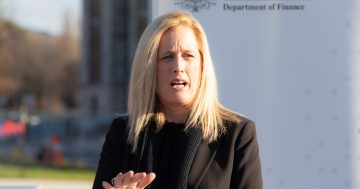
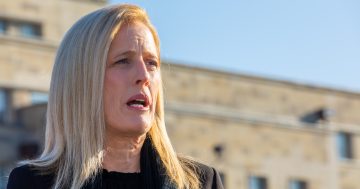
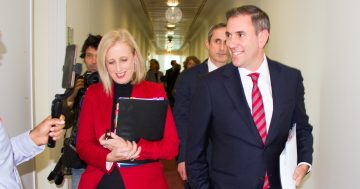
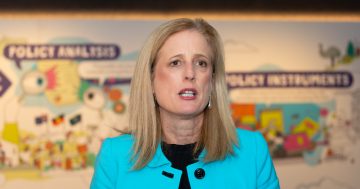
Finance Minister Katy Gallagher said savings have been found across the entire government. Photo: Michelle Kroll.
Next week’s federal budget will deliver savings across the entire Australian Public Service, with no department to escape forced cuts and belt-tightening.
Finance Minister Katy Gallagher confirmed on Monday (4 May) that the budget will include savings from every government portfolio, with the Expenditure Review Committee of Cabinet identifying numerous areas to target.
“On the expenditure side, this budget is a story about restraint and responsible savings. In the May budget, we will include bigger‑than‑usual gross savings than in previous updates,” Senator Gallagher said.
“It will build on the $114 billion delivered to date and … it will be the second economic update in a row that the government has saved more than we have spent, despite those pressures that you all understand coming at us.
“It is the result of a significant effort across the entire ministry to identify savings, and it will include savings and reprioritisations in every portfolio.”
The minister pointed to two “significant structural saves” already announced – the NDIS and the private health insurance rebate – and suggested there were similar announcements coming that would affect other agencies.
“I guess the message I’m saying there is, and I’ve been asked this in the last few days, is there will be savings across every portfolio,” she said.
“We’ve looked everywhere for savings. Ministers have worked really hard to support the effort that the ERC has undertaken in regard to this, and I think it’s a very strong result in the end.”
Senator Gallagher said while there are “pressures are coming at us” the government has had to manage through savings, “that right balance” has also been found through significant spending on such things as hospitals, the PBS, and natural disaster recovery payments.
The budget will also include $2.7 billion in savings in 2029–30 from reduced spending on external labour and non‑wage spending such as travel and hospitality across the APS.
Further savings on external consultants and lawyers will also be detailed.
The minister said it will essentially extend the existing savings measures from previous budgets, but will also include savings from unallocated funding across a number of departments.
“We have the efficiency dividend that’s built in, then this is over and above that, and it’s an extension of that,” she said.
“And that really is to maintain discipline across agencies that we expect them to be reducing their spending in those areas over time. And each year we have sent that message and we’ll continue to send it.”
While there are voluntary redundancy drives in numerous government agencies currently underway, Senator Gallagher said there had been no decision to force redundancies across the APS.
“On the story around redundancies across the APS, I’ve been clear consistently that we think the APS is essentially the right size it is now,” she said.
“We had to build it back from what we’d seen when we came into government, where we didn’t have the capability or the staff to do the job that the APS needed to do.
“We’ve built that back. It will move across departments from time to time.
“Our job is to provide agencies with the budgets they need to do the job that we ask them to do and that they’re required to do, and then secretaries manage those budgets, but we provide the allocation.
“There is no decision by the government to force redundancies … We do expect agencies to live within the budgets that the government has provided them.”
Treasurer Jim Chalmers said the Treasury and Finance departments are working through how the current global scenario affects the Australian economy to provide the central budget case.
The forecast for inflation will be a bit higher, while the forecast for growth will be a bit lower.
“Obviously, in a world where global oil prices, global inflation, global volatility extends for longer, then that will have more serious consequences for our economy,” the Treasurer said.
“The consequences of what we’re seeing in the Middle East for the Australian economy and for Australians is already serious and it risks becoming severe.
“We’ll do our best to try to explain and detail what a more severe scenario looks like in the budget.
“Obviously, that has consequences for inflation, for growth and for revenue too.”
Original Article published by Chris Johnson on Region Canberra.