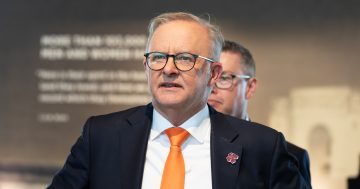
Prime Minister Anthony Albanese showing some rugby diplomacy to Pacific island nations. Photo: PM Facebook
Anthony Albanese’s past two weeks of diplomacy were a remarkable achievement for Australia’s Indo-Pacific relations, and they have not gone unnoticed.
What the Prime Minister achieved in just a few days has made it clear to nations across this strategically important region that Australia values them and is there for them – and that can only be good for Australia.
First to the Pacific, where attitudes and policy settings concerning this nation’s closest neighbours have ebbed and flowed over the decades depending on the importance Australia’s government of the day has placed on the island nations in the immediate region.
Platitudes and development aid have always been there, but sometimes they have been just tokenistic.
Pacific islands have sometimes been easily (if not overtly) dismissed by some key players in previous governments as too small and weak and even insignificant to warrant ‘unnecessary’ effort or attention.
Not by all Australian governments, however, and certainly not by the current Labor Federal Government.
While some still advocate for less, not more, Australian attention to the Pacific islands (hello, Paul Keating), their strategic relevance has never been greater, and Albanese knows it.
Since coming to office in 2022, the PM and his team, led by Foreign Minister Penny Wong, have made the Pacific a priority, reaching out in the very best examples of diplomatic effort.
And in just these past couple of weeks, much more has been achieved.
Security and defence agreements have been signed with Vanuatu and Fiji during two whirlwind tours that included the Prime Minister visiting his counterparts in the capitals of those two nations.
Three pacts were signed between them and Australia: first, the security treaty known as the Nakamal Agreement with Vanuatu; and both the Ocean of Peace Alliance and the Vuvale Union with Fiji.
The PM also advanced security and economic ties with the Solomon Islands, where he addressed that nation’s 48th Independence Day celebrations in Honiara.
Back in Australia, after returning from Fiji and the Solomon Islands, the Prime Minister hosted leaders from Papua New Guinea, Tonga and Samoa in Brisbane for regional security talks, bilateral meetings with each, and a champions’ view of the State of Origin decider which segued nicely into some big money from Australia to advance rugby league across the Pacific.
The PM launched a $250 million funding package over 10 years to build the NRL partnership with PNG, Samoa, Tonga and Fiji.
Sport diplomacy in the Pacific shouldn’t be downplayed.
As the Prime Minister said: “Through one of Australia’s favourite sporting codes, we are bringing our Pacific family closer together.”
The money will help set up competitions at the primary and high school levels in the Pacific, with a focus on girls, bolster men’s and women’s national competitions, and create more opportunities for NRL and NRLW matches to be played across the Pacific.
“A partnership between nations, leagues, clubs and schools but above all between peoples, a partnership built on the Pacific’s deep, shared passion for rugby league,” Mr Albanese said.
“For all of us, more than a sport: a language, a culture, a connection that is both family and faith.
“A bond that unites communities and inspires the next generation.”
This comes on the back of money for the PNG Chiefs, a planned rugby league team based in Port Moresby in 2028.
That deal was signed in 2024 with an understanding that PNG does not sign a security deal with China.
Of course, that is what much of Australia’s soft diplomacy in the immediate region is all about – attempts at countering any plans Beijing might have for a permanent military base in the Pacific.
That China tested a ballistic missile in the region while Mr Albanese was island hopping and signing treaties was a message from Beijing of its power and presence in this neighbourhood.
But the move has been largely described as an own goal and more a show of China’s petulance than its might.
The significance of Pacific island leaders joining with Mr Albanese in diplomatically yet firmly criticising China’s actions should not be underestimated.
When it comes to Australia’s relations with China, however, this government is also managing them well, offering friendship and respect and undoing much of the damage the previous Morrison government inflicted.
Meanwhile, it’s making progress with breakthroughs with Pacific island nations.
In addition to the previously mentioned agreements with Vanuatu and Fiji, the Federal Government now also has the Pukpuk Mutual Defence Treaty with PNG; the Falepili Union with Tuvalu; the Nauru-Australia Treaty; the Pacific Policing Initiative; the Pacific Response Group; and an agreed statement of intent to elevate the partnership with Tonga.
Australia has entered a new era of cooperation with Pacific island nations, and it comes at a vitally important time.
That brings us to the ocean on the other side of the country.
Australia’s relationship with India is also at an all-time high.

India’s Prime Minister Narendra Modi was warmly welcomed to Australia by Anthony Albanese. Photo: PM Facebook.
The third Australia-India Annual Summit hosted by Mr Albanese in Melbourne last week reinforced the two nations’ friendship.
India’s Prime Minister Narendra Modi was warmly and enthusiastically welcomed; defence and security cooperation was confirmed; economic, cultural and (importantly) sporting ties were bolstered.
Australia must maintain a positive, friendly and mutually beneficial relationship with India, which is a key player in the Indo-Pacific.
Australia’s Prime Minister made it abundantly clear that such is his intent.
Australia’s diplomacy across the Indo-Pacific has shone through in recent days, and the government is right to feel proud of what it has achieved.
Original Article published by Chris Johnson on Region Canberra.