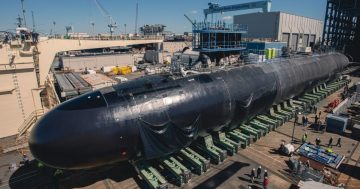
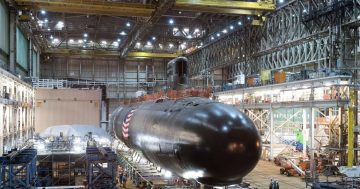
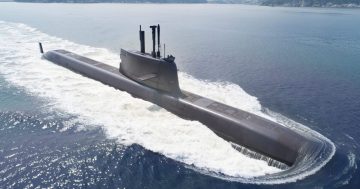
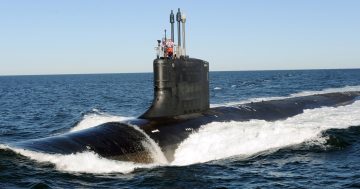
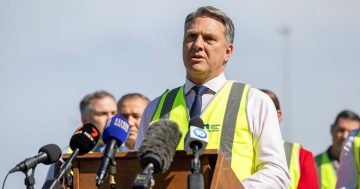
Defence Minister Richard Marles says the reduction in capability to just three used Virginia-class subs will result in savings and simplicity in operating different sub-classes of submarine. Photo: Kym Smith via ADF.
Fears that the US defence industry’s inability to increase its production rate of nuclear-powered submarines sufficiently to enable Australia to take delivery of up to three new boats have been realised following a trilateral meeting of AUKUS defence leadership in Singapore.
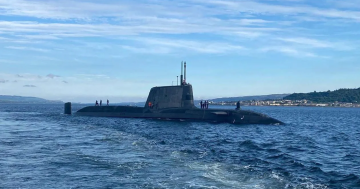
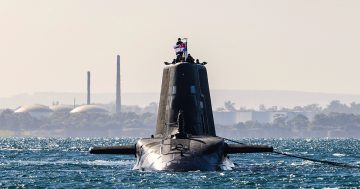
Australia was to receive two ‘’used’’ Virginia-class submarines from the US Navy from 2032, and then at least one and up to three new Virginias from 2038.
But following meetings on the sidelines of the annual IISS Shangri-La Dialogue in Singapore over the weekend, it has now been revealed that just three used Virginias will be allocated to Australia, and there was no mention of whether the fourth and fifth boats might still be offered.
While this will likely result in some savings for Australia, as well as the benefits of commonality between the three boats that will come from the same production ‘’block’’, this is a significantly watered-down version of the ‘’optimal pathway’’ to AUKUS Pillar I touted by the partner countries over the past three years.
Defence Minister Richard Marles has said the shift will result in unspecified significant savings for Australia, which has outlaid as much as $368 billion to acquire and operate a nuclear-powered submarine capability over the next three decades.
Mr Marles told media in Singapore that AUKUS was “incredibly complicated”, and that Australia needed to “place a premium on simplicity”.
“We had the prospect … of almost having four classes of submarines operating at the same time: the last of the Collins-class, two in-service Virginias, a brand-new Virginia, and a brand-new SSN-AUKUS. That gets pretty complicated,” he said.
“What we will have here is a simpler pathway. The Virginias we are acquiring will all be of the same type and I can’t overstate the significance of that. Chasing simplicity is at the heart of why we’ve pursued this.”
The Virginia-class has been constructed in block builds, with a breakdown of the 43 made so far or on order being four Block I, six Block II, eight Block III, 10 Block IV, 12 Block V and three Block VI boats. Later-block builds are significantly larger vessels with additional weapons, and have enhanced combat systems and sensors.
It is likely Australia’s boats will all be drawn from Block IV, built between 2014 and 2018.
In a 30 May joint statement, Mr Marles, UK Defence Secretary John Healey, and US Defense Secretary Pete Hegseth glossed over the revised Virginia-class arrangement, and instead said the rest of the optimal pathway to AUKUS I “remains on track to support Australia’s acquisition of a conventionally armed, nuclear-powered submarine capability”.
“The Deputy Prime Minister and Secretaries welcomed the proposed approach to streamline Australia’s acquisition of Virginia-class submarines, simplifying supply chain management, operational and maintenance requirements, and maximising cost efficiencies,” they said.
“This approach would enable Australia to acquire three in-service [Virginias] in lieu of a mixture of new and in-service variants.”
What Mr Marles didn’t talk about was: Where has Australia’s investment of more than US$3bn (A$4.2bn) in the US submarine industrial base, intended to help accelerate Virginia-class production, been used?
“Look, we have a sense of confidence about the production rates getting to where they need to get to,” Mr Marles told media.
“I mean, we’re well aware of the challenges in the US industrial base, but we’ve been aware about that from the very beginning when the optimal pathway was announced back in 2023.
”And that’s why we’re making a financial contribution to the US industrial base to help it increase its production rate. That is to create the space for the Virginia-class submarines to be transferred to Australia.
“But then there is the purchase price in respect of each of the submarines, and this will be more cost-effective in relation to that and it’ll be significant.”
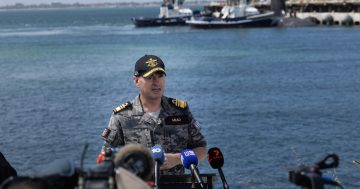
In a separate media briefing, Secretary Hegseth also expressed confidence in the US production ramp-up and its ability to deliver Virginias to Australia on schedule.
“I think they can, and that’s why we did the review the way that we did, is to bring it in, sure that what we’re promising is aligned with what we’re able to do,” he said.
“We’re laser-focused on making sure it happens, invest[ing] in American capabilities, American jobs that will deliver our ability to project those subs, but also provide inside this arrangement, but it’s mutually beneficial.
“Those subs, obviously in the hands of Australia, are important for your defence, but they also add to the combined defence of what we would need to do. Heaven forbid there were a contingency.”