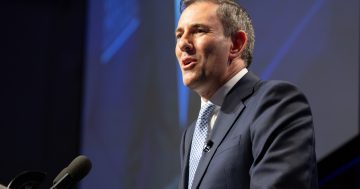
Treasurer Jim Chalmers says Australia’s economic growth is “very solid under the circumstances”. Image: Screenshot.
The Federal Government is defending national accounts figures showing a decline in gross domestic product growth in the quarter to March, with productivity having its sharpest fall in two years.
The Australian Bureau of Statistics released the latest figures on Wednesday (3 June), showing that GDP rose 0.3 per cent in the March quarter this year, and 2.5 per cent compared to a year ago.
The 0.3 per cent growth in the March quarter is the weakest growth in the past year and below market expectations, and productivity is down 0.6 per cent over the quarter. GDP per capita declined 0.1 per cent over the quarter.
ABS head of national accounts Grace Kim said economic growth slowed in the March quarter, with modest household and public-sector expenditure and cyclone disruptions to mining and export activities.
“Rising interest rates and significantly higher fuel costs in March likely created an environment for more cautious consumer behaviour,” she said.
“This resulted in reduced spending across a range of household expenditure categories.”
Household spending rose 0.5 per cent in the March quarter, which includes elevated spending on electricity, gas and other fuels (up 11.7 per cent) as government rebates ceased, increasing out‐of‐pocket expenditure for households.
Household spending on essential goods and services increased by 0.8 per cent, while discretionary spending rose by 0.1 per cent.
Household spending results in this latest data release predates the halving of the fuel excise on 1 April.
It all means real GDP growth slowed to 0.3 per cent in the first quarter of this year, down from 0.9 per cent in the previous quarter. Annual growth remained steady at 2.5 per cent.
Treasurer Jim Chalmers has put as positive a spin on the figures as possible, describing Australia’s economic growth as “very solid under the circumstances“ and growing “faster than almost every major advanced economy”.
“And it’s above the OECD average,” he said, adding that while the “economy’s got no shortage of challenges”, it has also got “some very sturdy” foundations.
“This is the equal fastest annual growth in almost three years,” Dr Chalmers said.
“It shows how resilient our economy is at a time of very substantial global economic volatility and instability, but the really big story here is about the private sector, and particularly when it comes to business investment.
“Private sector investment in Australia is booming.”
The ABS figures show private business investment rose 6.0 per cent, driven by a 16.3 per cent increase in machinery and equipment.
The machinery and equipment investment recorded the largest rise in 30 years.
Government final consumption expenditure fell 0.2 per cent, the lowest quarterly growth since the September quarter of 2022.
Commonwealth spending slowed from recent high levels of defence expenditure, while state and local government spending fell 0.8 per cent following the ending of electricity rebate payments.
“These business investment figures are incredibly welcome,” the Treasurer said.
“They’re also the key reason why private demand grew faster than public demand in the quarter … It’s not surprising that the quarterly productivity number fell, but we didn’t see productivity go backwards for the preceding five quarters.
“Before this data, we saw some welcome developments on productivity, but we didn’t get carried away because we know that this is a long-standing challenge, and it will take some time to shift in the budget.”
Shadow treasurer Tim Wilson said Labor’s most recent Federal Budget will worsen the economy.
“Today’s national accounts show the Albanese Government’s economic policy is crashing the Australian economy, and Australians’ standards of living are declining”, he said.
“Now we’re in a position where we’ve got higher taxes, higher inflation, and of course, Australian households are doing worse, and we have record small business insolvencies.
“This is not an environment for optimism or growth. Australians need hope, and it’s not going to come from higher taxes, higher inflation and lower living standards.
“These numbers show what is to come, and unfortunately, the Treasurer is making a bad problem worse through his budget.”
Original Article published by Chris Johnson on Region Canberra.