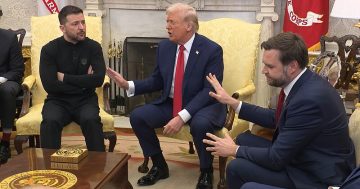
The defence and security agreement was signed on 24 September when Ukraine’s President Volodymyr Zelenskyy (left) and Australian Prime Minister Anthony Albanese met at the United Nations General Assembly in New York. Photo: President Zelenskyy media page.
Prime Minister Anthony Albanese and President of Ukraine Volodymyr Zelenskyy signed a bilateral defence and security agreement on the sidelines of the United Nations General Assembly in New York last week.
A joint statement from Mr Albanese, Foreign Minister Senator Penny Wong and Defence Minister Richard Marles said the agreement provided a framework for security cooperation and affirmed Australia’s enduring commitment to Ukraine.
Under the agreement, Australia will provide an additional $60 million in support to Ukraine, comprising $45 million in undefined Australian Defence Force military equipment, $10 million for Ukraine’s Energy Support Fund, and $5 million in humanitarian assistance.
The statement said the additional funding would bring Australia’s total contribution to Ukraine to almost $1.9 billion.
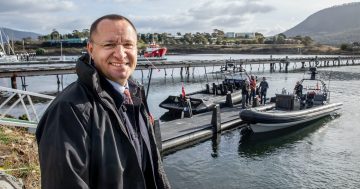
So far, Australia has provided 120 former Australian Army Bushmaster protected military vehicles, 49 M1A1 Abrams main battle tanks, 28 M113AS4 armoured personnel carriers, M777 towed 155mm howitzers, tactical air defence radars and missiles, anti-tank missiles, Tasmanian-built rigid-hull inflatable boats, JDAM-ER GPS-guided bombs, various types of ammunition, and military clothing.
Australia is also providing training to Ukrainian recruits in the UK under Operation Kudu, and has twice deployed an E-7A Wedgetail airborne early warning and control aircraft to Germany and Poland to assist in NATO’s air defence of central Europe.
The Australian Government has also joined the eight-member-nation drone coalition to aid Ukraine in its war by supplying thousands of commercially derived drones that can be modified for military use.
Australia announced it would also join the UK and Norway-led Maritime Capability Coalition for Ukraine, to support the development of Ukraine’s navy, and that the government had imposed additional sanctions on Russia.
The government said that, since Russia’s invasion in 2022, Australia’s position had been clear in condemning the assault, which it said was a clear violation of international law and the United Nations Charter.
Mr Albanese said it was an honour to meet President Zelenskyy again.
“I am always struck by his determination, courage and allegiance to the Ukrainian people,” he said.
“This Bilateral Security Agreement underscores Australia’s ongoing commitment and enduring support for Ukraine as it defends itself against Russia’s aggression.
“Australians stand with Ukraine.”
Senator Wong added: “Australia has been steadfast in our support for Ukraine since Russia’s unprovoked and unjustified full-scale invasion.
“We will continue to provide unwavering support to Ukraine and we will continue to work with partners to impose costs on Russia and starve its war machine.
“Australia wants to see a lasting peace that upholds Ukraine’s sovereignty and territorial integrity, supports security and stability in Europe, and ensures Russia does not renew its aggression.”
In a separate statement, President Zelenskyy said the Australian people had always stood with Ukraine.
“Thank you for your real and concrete support — military, energy support, which has been critically important, and humanitarian assistance.
“Once again, thank you for your support and for always standing with us — both politically and geopolitically.”
President Zelenskyy added that Ukraine was ready to share its experience and technologies with Australia.
“Naval drones, ground platforms and AI-powered systems — all of these go far beyond purely combat applications and can significantly strengthen national security,” he said.
In a 24 September LinkedIn post, Ukraine’s ambassador to Australia Vasyl Myroshnychenko said he was pleased with the outcome of the meeting in New York between Mr Albanese and Mr Zelenskyy.
“The Bilateral Security Agreement is signed — it’s a milestone,” he said.
“This agreement is comprehensive. It includes lots of parts of our cooperation in defence, security, border control, economic cooperation, cyber. There is so much out there and I’m so pleased that we’ve managed to get this result.
“Most importantly, this agreement marks the connection between security in Europe and security in the Indo-Pacific.
“I’m personally grateful to Prime Minister Anthony Albanese for his support, for being out there. His emotional remarks have really been very heartening to everybody who saw it in Australia and in Ukraine as well.”
In a 25 September statement on its website, the Russian Embassy in Australia described the assistance package as “another waste of Australian taxpayers’ money”.
“Another shot in the arm to the corrupt neo-Nazi Kiev regime. Another step towards prolonging the conflict,” it reads.
“New anti-Russian sanctions have also been introduced, bringing their total number up to 1900.
“Have such vain efforts in any way changed Russia’s resolve and capacity to battle Nazism again, as it did during WWII, and achieve the goals of the special military operation? The answer is NO — and they will not.”