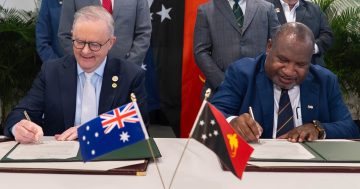
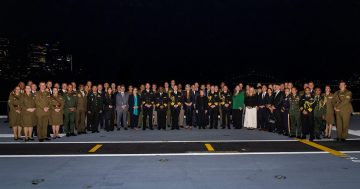
New Zealand Defence Minister Judith Collins and her Australian counterpart Richard Marles sign the Operationalising our Alliance statement on 17 March. Photos: ADF.
Australia and New Zealand have agreed to forge closer defence ties during the annual ANZMIN summit.
Australian Foreign Minister Senator Penny Wong and Defence Minister Richard Marles, and their New Zealand counterparts Winston Peters and Judith Collins, signed the Operationalising our Alliance agreement in Canberra on 17 March.
The agreement will build upon the 2024 Closer Defence Relations construct and will see the two countries strive to “operationalise” the alliance with the goal of integrating the New Zealand and Australian defence forces to operate seamlessly by 2035, while remaining respectful of each other’s sovereign status.
The agreement says the NZDF and ADF are already doing significant work to strengthen integration, but will build on that by exploring opportunities to procure common equipment and develop common platforms and systems where it makes sense to do so.
A joint statement says the agreement comes in the face of “a sharply deteriorating security environment”, and that the two countries “must be ready to meet the security threats we face today and in the future”.
“We will be force multipliers for each other and combine our military forces in defence of our sovereignty, shared interests, and common values, and territory,” it says.
The agreement will focus on six ‘’lines of effort’’.
“Operationalising our Alliance includes lines of effort across force posture activities, combined operations and exercises, preparedness, defence industry integration, resilience, and Pacific security as ways to protect our sovereignty and uphold regional security,” it says.
These force posture activities will place a greater emphasis on being able to train and operate from each other’s territory, and to project force to deter actions contrary to the region’s security or in response to crises.
This will include increased rotational activities in both countries and the establishment of an Australia-New Zealand Force Posture Working Group to develop recommendations to advance force posture cooperation.
It also recognised that Australia and New Zealand’s combined operations and exercises in the Indo-Pacific are an important contribution to deterring potential threats and promoting stability in the region.

A Royal New Zealand Air Force C-130J Hercules from No 40 Squadron was recently integrated with the RAAF’s No 37 Squadron at Richmond, near Sydney.
The agreement will look to increase the complexity of combined operations and exercises so that, by 2035, both forces can be seamlessly integrated.
This will include operating and exercising as a more integrated Anzac force alongside other allies and partners; deploying increasingly integrated and interchangeable units; and strengthening combined mission planning, combat readiness, and synchronisation mechanisms, including through the presence of embedded staff in each other’s strategic and operational headquarters.
Common and complementary abilities the NZDF and ADF will seek to acquire include strike capabilities in a variety of domains, autonomous systems, maritime and air platforms and equipment, and land systems.
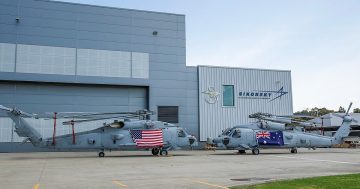
The two nations’ defence forces already operate some common equipment — both air forces fly the C-130J-30 Hercules transport and P-8A Poseidon maritime response aircraft, and New Zealand ordered MH‑60R helicopters.
The Royal New Zealand Navy operates two Anzac-class frigates similar to six Anzacs in Australian service, and has shortlisted the Japanese Mogami-class frigate, which Australia is also buying to replace its Anzacs.
Other lines of effort the two countries will seek to strengthen include force preparedness, resilience and defence industry integration through collective capabilities and self-reliance within the alliance construct.
To achieve this, both nations will seek to develop sovereign capabilities and industries while reducing barriers to defence industry participation, explore opportunities to co-develop common capabilities, leverage sustainment and logistics services, and optimise collective training and education exchanges and attachments.
On the sensitive issue of Pacific security in the face of an increased Chinese presence, the agreement recognises that our security is “inextricably linked with the security of the broader Pacific region”.
“Recognising our shared geography and the importance of our defence relationships with our Pacific partners, we will continue to support combined operations and exercises in the Pacific,” the agreement says.
It says that, by 2035, Australia and New Zealand will increase Pacific defence force interoperability with a focus on embedding the Pacific Response Group as a regional asset, expand combined operations and activities in the region, increasingly work through the South Pacific Defence Ministers’ Meeting (SPDMM) to meet defence needs of the Pacific, and increase support to Pacific-led combined maritime activities.
“The ANZMIN is a critical opportunity to engage with Australia — our closest friend and only formal ally — to set the strategic direction and confirm our shared approaches to foreign policy, security, and defence,” Mr Peters said in a statement before the meeting.
“New Zealand and Australia face the most unpredictable and dangerous strategic environment in decades. In the face of this instability, our commitment to work together is as strong as ever.”
At a media briefing after the signing, Ms Collins said: “Our alliance as peoples is built not only on our shared history, our shared position in the world geographically, but actually our shared values. And never has there been such a time that we need to value those shared values.”