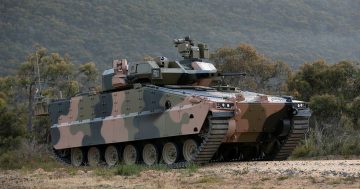
The ANAO found it will be difficult, if not impossible, for the LAND 400 Phase 3 AS21 Redback project to meet its planned delivery schedule. Photo: ADF.
A report by the Australian National Audit Office (ANAO) has identified risks in key elements of an Army armoured vehicle program.
The Project LAND 400 Phase 3 is acquiring the Hanwha AS21 Redback Infantry Fighting Vehicle (IFV) to replace the Australian Army’s upgraded Vietnam-era M113AS4 Armoured Personnel Carriers (APC).
The AS21 was selected by the Army ahead of the rival Rheinmetall KF41 Lynx IFV in July 2023, and has been under development to meet Australian requirements since.
Despite the government announcing it would accelerate the project by two years ahead of the previous Coalition government’s plans, the April 2023 Defence Strategic Review (DSR) saw the planned buy if IFVs reduced from 450 to just 129.
The original budget for 450 vehicles of $10 to $15 billion as laid out in Defence’s 2016 Integrated Investment Plan (IIP) increased to between $18 and $27 billion in the 2020 IIP. But, as of February 2026, the project has an approved expenditure of $7.3 billion for just 129 vehicles.
A contract for the IFVs was signed in December 2023, and the vehicles will be manufactured at Hanwha Defence Australia’s armoured vehicle centre of excellence (H-ACE) at Avalon Airport near Geelong. Initial deliveries are scheduled to commence in early 2027, with the final delivery planned for December 2028.
But a new report from the ANAO has found the purchase of the Redback by Defence has only been “partly effective”, with risk identified in Defence’s concurrent acquisition process while the vehicle is still in development.
It found that, as of October 2025, there were two very high technical risks which, if not effectively mitigated, could materially affect the vehicle’s mobility and lethality.
“These risks arose from Defence‑mandated systems integration requirements and the use of components that were not yet mature and proven in a vehicle of the IFV’s nature,” it said.
“The compressed delivery schedule further compounded these risks by reducing the time available to identify, test and remediate issues before key milestones.
“Defence’s acquisition approach evolved from its original intent to pursue a mature and proven solution, resulting in a more developmental pathway with greater exposure to integration and schedule risk,” it said, adding that, “These risks were not clearly communicated to government, nor consistently reflected in tender evaluation and contracting decisions.
“Contrary to successive Defence procurement reviews, Defence did not provide government with advice on potential mature and proven options for Land 400 Phase 3, even though it possessed this information.”
The report also found “inconsistencies” in how tendered prices and risks were adjusted which, it says, “reduced the transparency and defensibility of the value for money assessment”.
“The tender evaluation process was weakened by inconsistent treatment of risk and price adjustments, as well as the absence of clearly articulated weighting or prioritisation of evaluation criteria in the tender documentation,” it says.
It also questions the contracting arrangements with Hanwha.
“Defence established partly effective contracting arrangements with Hanwha Defence Australia (HDA) to support the delivery of intended contract outcomes,” it says.
“However, there are a number of very high risks to core elements of the vehicle, the impact of which on the long-term project schedule, cost and overall capability are unknown at this stage.”
The project has already missed a couple of key deadlines, with the key Integrated Baseline Review being completed some four months late in December 2024, and the Detailed Design Review nearly six months late in December 2025.
It says Defence was advised by independent reviewers that delivering the capability within the accelerated schedule is “extremely challenging, given there is limited time for issue remediation”, and that it will be a significant, if not impossible, challenge to deliver 129 fully capable IFVs by the end of 2028.
These delays have resulted in the LAND 400 Phase 3 program being placed on the Capability Acquisition and Sustainment Group’s (CASG) Watch List, just one level below the government’s dreaded Projects of Concern List.
The ANAO’s findings are accompanied by two key recommendations to which Defence has agreed.
These are: that when presenting capability investment proposals to government, Defence include explicit advice about the extent to which mature or proven options exist in the market; and that Defence strengthens its compliance with government policy to ensure that contract payment terms are in accordance with government policy.
In its response to the report, Defence said it acknowledged the “very high” risks that were identified, and noted that “these risk are subject to mitigation action by the project”.