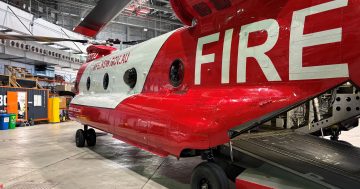
The Federal Government has funded the lease of five aircraft for the upcoming fire season, including a Coulson C-130Q Hercules based at RAAF Richmond. Photo: Coulson.
The Australian Government has bolstered the National Aerial Firefighting Centre (NAFC) and the national fleet of firefighting aircraft with an investment of more than $150 million over the next three years.
An El Niño event is well underway, raising concerns about a hotter, drier summer ahead and a higher-risk weather season.
The government says the investment will fund a small fleet of aircraft and the ability to coordinate the deployment of nearly 170 multi-use aircraft funded by states and territories for their own aerial firefighting requirements.
For 2026-27, the Federal Government will fund five aircraft, including a National Large Air Tanker (LAT) Lockheed C-130Q Hercules, a ‘’Birddog’’ Cessna Citation 550, a Bell 214ST helicopter, and two Sikorsky UH-60L Black Hawk helicopters. The NAFC coordinates these and other aircraft funded and operated by state governments in responding to fire emergencies.
Minister for Emergency Management Kristy McBain said the national aerial firefighting fleet was ready to respond quickly when needed, helping protect communities during emergencies.
“The government is committed to supporting communities impacted by bushfires and other natural disasters — whether that’s through our aerial capabilities, investment in risk reduction, our national messaging system AusAlert or our National Emergency Management Stockpile,” she said.
“The additional funding we’ve announced today will ensure aerial assets can be deployed right across the country, wherever they are needed.
“The fleet is in position and ready to respond to disasters this higher-risk weather season.
“The important part about our aerial capability now is not only does it deal with fires, but also with evacuations, resupply when isolated communities are cut off, and animal welfare like emergency fodder drops.
“We’ve made sure this fleet is fit for every event that may impact Australians’ lives over this next higher-risk weather season.”
The interim coordinator of the National Emergency Management Authority (NEMA), General Patrick Hetherington, said his agency had been working with states and territories in preparation for the anticipated higher-risk weather season.
“In early September, we brought together over 300 people from the emergency services sector, community sector, industry and local government to get our plans in order for the season ahead,” he told media at RAAF Base Richmond on Monday (2 November).
“Through a series of scenario-based exercises, we tested our plans and capabilities against the hazards we are most likely to see in the upcoming season.
“With the government’s investment of $150 million in national aerial firefighting capability, we are confident that we have the aircraft we need for this season and the seasons ahead.”
NSW Rural Fire Service Commissioner Trent Curtin said RAAF Richmond had become a key strategic east coast LAT base.
“This gives us the capability to deploy large air tankers across NSW and right across the eastern seaboard of Australia,” he said.
“We’re expecting to see some dangerous conditions this summer.
“We’ve seen dry and hot conditions in various parts of the country and communities can be under threat. We’re expecting homes to once again be under threat and lives to be at risk.
“What we’ll have is large air tankers, supported by this new investment from the government, to support states and territories with existing aviation firefighting fleets to protect communities in their time of need.”
However, opinions vary over whether this summer will follow the model of previous El Niño events, which brought drier conditions to the east coast.
The Insurance Council of Australia has warned policyholders to be ready for a wetter-than-usual summer. In a 29 October statement, the council said 2026 was on track to be Australia’s wettest El Niño year on record, particularly after widespread storm activity across parts of Queensland and the Northern Territory in October.
Deputy CEO Kylie Macfarlane said: “Recent years have taught us that extreme weather doesn’t always follow the forecast or the season, and communities that haven’t seen a major event in a long time can be caught off guard when one arrives.”