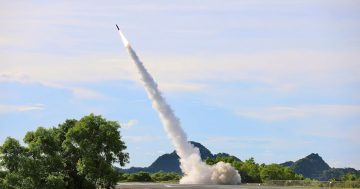
An AMRAAM is launched from a NASAMS six-shot cannister launcher. Photo: ADF.
A key element of the Australian Defence Force’s growing need for advanced air defence systems recently achieved a final operational capability (FOC).
The enhanced NASAMS short-range ground-based air defence system (SRGBAD) declared its FOC in late June after the major elements of the system were delivered and all of the major test, training and sustainment requirements were delivered to the Army.
The NASAMS system was delivered under Project LAND 19 Phase 7B and is operated by Army’s 16 Regiment Royal Australian Artillery at Edinburgh near Adelaide.
The system was integrated by Raytheon Australia, with major elements of the system supplied by Kongsberg Australia, Canberra’s CEA Technologies, Thales Australia, and many other Australian companies.
The system will form the inner layer of the ADF’s integrated air and missile defence (IAMD) system. SRGBAD systems are designed to protect bases, deployed units, and small to medium sized infrastructure from attack by threats such as aircraft, large drones, helicopters, and cruise missiles.
Australia’s NASAMS differs from similar systems operated in the US and Europe, in that it uses advanced Australian-designed CEA Technologies radar arrays and a Raytheon MTS-A electro-optical/infrared (EO/IR) sensor, and is integrated with armoured Australian Army Hawkei and HX vehicles.
It is able to fire radar-guided AIM-120C-5 AMRAAM or AIM-9X infrared-guided missiles at targets out to a 25 km radius.
Other layers of the planned IAMD will include the current nascent requirement for a medium-range (MRGBAD) system which will have much greater range and the ability to defend against ballistic missiles, and the multi-phased Project AIR 6500 joint air battle management (JABM) system currently being delivered to the ADF by an industry team led by Lockheed Martin Australia.
The JABM system will tie together all of the ADF’s air defence elements, including the ground-based wide-area JORN radar system, the Royal Australian Air Force’s E-7A Wedgetail command and control aircraft and F-35A combat aircraft.

The Thales Hawkei mobile launch vehicle (left) and the fixed six-cannister launcher are key elements of the NASAMS system. Photo: ADF.
It will also use data from the Royal Australian Navy’s Hobart-class destroyers and forthcoming Hunter-class frigates with their Aegis combat systems and medium-range air defence missiles.
When fully operational, JABM will present a common operating picture of the airspace around Australia using data from all of these systems in addition to civil and military air traffic control systems.
The declaration of FOC coincides with an additional six-year $2.4 billion investment by government into Phase 2A of AIR 6500 which will add additional capabilities to the JABM including its ability to network with other systems, command and control functions, and increased support for the Australian industrial base.
Minister for Defence Richard Marles said the additional investment in AIR 6500 would ensure the [ADF] could respond effectively to future threats and deliver on the priorities of the government’s National Defence Strategy and the Defence Industry Development Strategy.
“The project will upgrade the command and control systems needed to strengthen the Australian Defence Force’s ability to detect, track and respond to threats in an increasing complex strategic environment.
Mr Marles also described the declaration of FOC of NASAMS marks a significant milestone in strengthening Australia’s integrated air and missile defence capability.
“NASAMS provides Army with a modern, highly capable air defence system that enhances our ability to protect [ADF] personnel, critical assets and infrastructure from a range of airborne threats,” he said.
“This capability reflects Defence’s commitment to ensuring the [ADF] remains equipped to respond to an increasingly complex strategic environment.”
Minister for Defence Industry Pat Conroy described the system as a “world-leading capability” for Defence.
“NASAMS demonstrates how Defence and industry are working together to deliver advanced capability and operational outcomes for the Australian Defence Force,” he said.
“Australian-designed radar technology is a key part of this capability, highlighting the important contribution local industry makes to Australia’s national security.
“This milestone marks the culmination of years of collaboration between Defence, Australian industry and international partners to deliver a world-class air defence system for the Australian Army.”
In a brief post on LinkedIn, Raytheon Australia managing director Ohad Katz said, “Australia reaching final operational capability with NASAMS is more than a program milestone — it means the system is fully integrated, trained and ready to deliver the protection Australia needs today.”