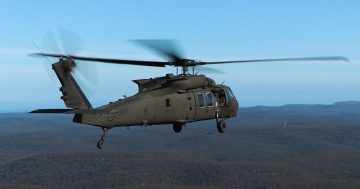
A formation of 1Avn ARH Tiger helicopters flying over Darwin on 24 September. Photo: ADF.
The Australian Army’s fleet of Airbus EC635 Tiger armed reconnaissance helicopters (ARH) will be retired from service on Wednesday (30 September).
The 22 Tigers are being replaced by Boeing AH-64E Apache Guardian attack helicopters, six of which have been delivered to the army at Townsville, and all 29 of which are planned to be in service by 2029.
A formation of the Darwin-based Tigers conducted a flyover of the city on 24 September to acknowledge the community’s support during the aircraft’s 22-year service career with the army. After the flyover, the 1st Aviation Regiment (1Avn) held an open day for its members and families, and a formal dinner.
Commander Army Aviation, Major General David Hafner AM CSC, said the ARH Tiger had provided the army with an armed reconnaissance capability for two decades.
“The end of ARH Tiger flying operations is a significant moment for the 1st Aviation Regiment, but it also marks the beginning of an exciting new chapter as we continue our relocation to Townsville and further build Australia’s attack helicopter capability around the AH-64E Apache,” he said.
“Our soldiers, aircrew and maintainers have achieved an extraordinary transition from the ARH Tiger to the Apache while continuing to deliver training and operational outputs.
“Their dedication has ensured the army remains ready for the future.”
In preparation for the Apache’s arrival and 1Avn’s move to Townsville, some $700 million has been invested in critical infrastructure upgrades and facilities works at the base since 2024. This includes accommodation for the 16th Aviation Brigade headquarters, which has relocated from Brisbane.
Also being built are new aircraft hangars and renovations to existing hangars, new working accommodation, training and command facilities, a simulation hall to accommodate Apache Pilot Simulation Training and the Army Aviation Training Centre Attack Helicopter Wing, and a multistorey carpark for base personnel.


The new Apaches are based alongside the army’s 14 Boeing CH-47F Chinook heavylift helicopters of C Squadron 5Avn, while Royal Australian Air Force F-35A Lightning II, F/A-18F Super Hornet and EA-18G Growler combat jets will continue to visit the base for course graduations and other major exercises.
A contract for the 29 Apaches was confirmed in March 2023 as part of a larger US Army order, with an estimated overall project cost of more than $5 billion.
This whole-of-project amount likely includes the cost of establishing those new facilities at Townsville and decommissioning those at Darwin, although Darwin will probably remain as a staging point for Apache visits to the NT as well as visiting US Marine Corps and other services’ helicopters.
The first two Apaches were delivered to RAAF Base Townsville in North Queensland aboard a US Air Force C-17A transport in September 2025.
Procured under the Project LAND 4503 ARH replacement program, the new aircraft are larger and more powerful than the Tigers they will replace, and are essentially identical to new Apaches in service with the US, UK, the Netherlands and other allied forces.
Similar to the now-retired MRH 90 Taipan, which was also built and sustained by Airbus, the Tiger had a troubled service life, with many of the same issues of parts availability and excessive maintenance hours per flight hour.
The AIR 87 project, which resulted in the Tiger being bought, was the subject of two scathing Australian National Audit Office (ANAO) reports in 2006 and 2016, and Australia’s aircraft were grounded for an extended period following the 2017 crash of a French Tiger in Mali.
But since being returned to flight, the Tiger has enjoyed greater levels of availability and reduced operating costs, and anecdotally was universally liked by its crews for its speed, agility and manoeuvrability.
Also like the Taipan, the Tiger is being replaced by a helicopter it was originally selected ahead of way back in 1999. At the time, the Tiger was considered cheaper, faster and nimbler than the Apache, and offered the same potential benefits of local assembly and sustainment as the MRH-90.