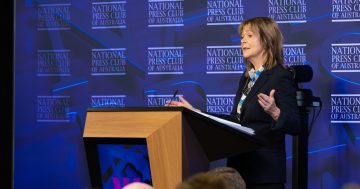
ACTU secretary Sally McManus says Australian workers deserve an extra week of leave each year. Photo: Supplied.
Australian workers want an extra week of annual leave and the union movement is on their side to help them get it.
The Australian Council of Trade Unions (ACTU) has launched a campaign to increase annual leave entitlements from four to five weeks for full-time workers and from five to six weeks for those who are regular shift workers.
While the business lobby isn’t too thrilled with the idea, the ACTU says the increase would be the first in the minimum working standard since the mid-1970s.
“Australians work relatively long hours, which has only increased over time, yet the four-week annual leave standard was set 50 years ago,” ACTU secretary Sally McManus said on Wednesday (4 March).
“Extra leave will decrease stress and burnout. Australian workers already do an extra four and a half weeks of unpaid work on average every year.
“Getting back one of these weeks is fair and reasonable. It will mean a better rested and happier workforce.”
The union campaign is calling on the Federal Government to change the National Employment Standards (NES) to bring in the extra week’s annual leave.
The push comes as a House of Representatives inquiry into the NES is about to get under way.
The ACTU says that while Australians work longer hours, the gap between productivity and real wages has widened.
Based on analysis by the Centre for Future Work, an initiative of the Australia Institute, real wages would need to increase by an additional 10 per cent to catch up to increases in productivity since 2000 and close the gap that has opened up over the last two and a half decades.
The unions say allowing workers an extra week of leave would help with closing that gap.
Increasing annual leave by one week, they say, would add an extra two per cent to employment costs that would be offset by a reduction in employee turnover and time lost to injury and stress.
Ms McManus said younger workers in particular, those aged between 18 and 24, were the ones doing the most unpaid work and who most urgently needed to see this burden start to lift.
“They [work] an average of 6.4 weeks of free work for their employers each year,” she said.
“The majority of European countries have already moved beyond four weeks. Countries like Austria, France and Spain have already recognised the importance of rested, healthier employees and have higher rates of annual leave than Australia does.
“They are some of the most productive and competitive economies in the OECD.
“It’s time Australia caught up, our annual leave has been frozen at four weeks since the mid-1970s, half a century ago. Most workers weren’t alive when annual leave last went up in Australia.
“Extra leave will also start to address the productivity gap that workers face. The average Australian would need to see their real wage increase by 10 per cent to make up the difference between productivity improvements and real wage growth since 2000.
“An extra week of annual leave would help to reduce that gap.”
The union movement also cites Germany, Portugal, Denmark, Iceland, Norway and Sweden as examples of European countries now providing more annual leave for their citizens than does Australia.
Australian Industry Group, however, said the ACTU’s proposal was flawed and should be rejected.
AI Group chief executive Innes Willox said individual businesses already worked out conditions and entitlements with their workforce as a matter of course, which can vary from work site to work site, depending on the circumstances facing those businesses.
“The ACTU’s demand is both predictable and predictably out of touch with reality,” he said.
“Australia faces a productivity crisis that is driving up inflation, putting pressure on interest rates and leading to declining living standards and business conditions.
“An extra week off will solve none of these problems. It would just make them worse.
“Citing increasingly economically irrelevant high tax European welfare states as beacons Australia should follow to implement centralised one-sized fits all approaches to wages and conditions simply undermines their case.
“The competitive landscape is changing rapidly.
“Only those living in a fool’s paradise would argue for more leave with no productivity dividend in a country where businesses are under real pressure, where we can’t get near our targets on new housing or new energy rollouts and where one state is crazily proposing everyone should be entitled to work from home two days a week.
“This proposal falls into the category of be careful what you wish for. It should be immediately rejected.”
Original Article published by Chris Johnson on Region Canberra.