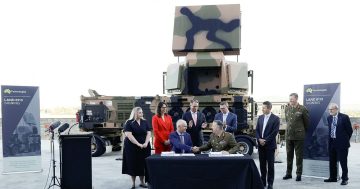

CEA Technologies CEO Alan Clements, Interim UK National Armaments Director Nadine Williams, Chair of CEA Technologies Joycelyn Morton, Minister for Defence Industry Pat Conroy, UK Minister for Defence Readiness and Industry Luke Pollard, UK Director General International National Armaments Director Group Avril Joliffre, Australia QinetiQ CEO Corry Neale, Head of Air Defence and Space Systems Division Air Vice-Marshal Martin Nussio, and CEA Engineering Development Manager Craig Hill at the signing on 12 August. Photo: QinetiQ.
Australia and the UK have signed an agreement to progress the possible acquisition of Australian-designed radar systems by the UK Ministry of Defence (MoD), with reports indicating a possible future $10 billion contract with the UK could be Australia’s largest-ever defence sale.
The advanced electronically scanned array (AESA) radar systems are designed and built by Canberra-based majority Government-owned CEA Technologies, and the agreement includes British company QinetiQ, which will play a role in the integration, testing and assurance of the arrays into the UK defence system.
The joint statement signed between Defence, CEA, QinetiQ and the UK MoD on 12 August was witnessed by Defence Industry Minister Pat Conroy, and visiting UK Minister for Defence Readiness and Industry Luke Pollard.
The agreement recognises the strategic importance of collaboration between both nations’ defence departments and defence industries, and commits Australia and the UK to working closely together to implement the AESA radar initiatives announced in June’s Australia-UK Ministerial Consultations (AUKMIN) summit.
The agreement aligns with the AUKUS Pillar 2 construct which seeks to deepen cooperation between Australia, the UK, and US on a number of advanced technologies including cyber, hypersonics, undersea technologies, uncrewed systems, quantum computing, and electronic warfare.
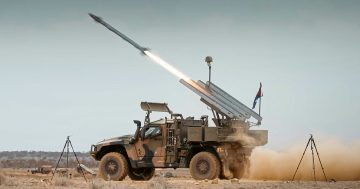
In Australian Defence Force service, CEA arrays are used for search and air defence on the navy’s ANZAC-class frigates, on the amphibious vessel HMAS Choules, as key sensors for the Army’s new NASAMS short-range air defence and HIMARS long-range fires systems, and as threat emulators on the Air Force’s electronic warfare training range in support of the EA-18G Growler electronic attack aircraft.
CEA is also developing the main sensor for the Navy’s new Hunter-class frigates from 2032.
Minister Pollard said Australia and the UK were deepening their industrial cooperation with Australia on cutting-edge radar technologies.
“By bringing QinetiQ’s expertise together with CEA’s world-class radar technology, we can strengthen the warfighting readiness of both our nations while backing jobs and growth on both sides of the world,” he said.
Group CEO of QinetiQ, Steve Wadey added, “QinetiQ’s unique expertise positions us as a strategic and trusted partner to the UK Ministry of Defence and its allies.
“Current conflicts remind us of the importance of air defences, which are increasingly under pressure, and QinetiQ is proud to play a key role in bringing this vital technology to the UK.”
The new CEO of CEA Technologies Alan Clements said the signing was an important milestone for CEA and the Australian and UK defence industries.
“It reflects the confidence both governments have in CEA’s world-leading radar technology and the important role industry partnerships play in strengthening sovereign capability.”