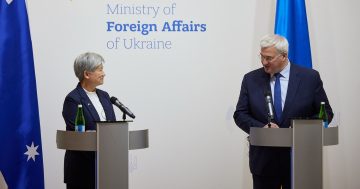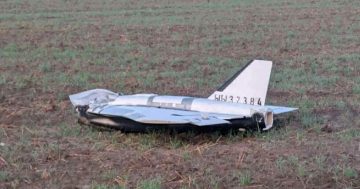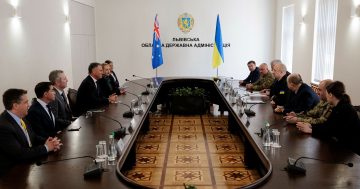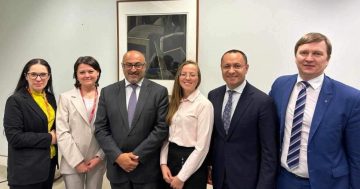

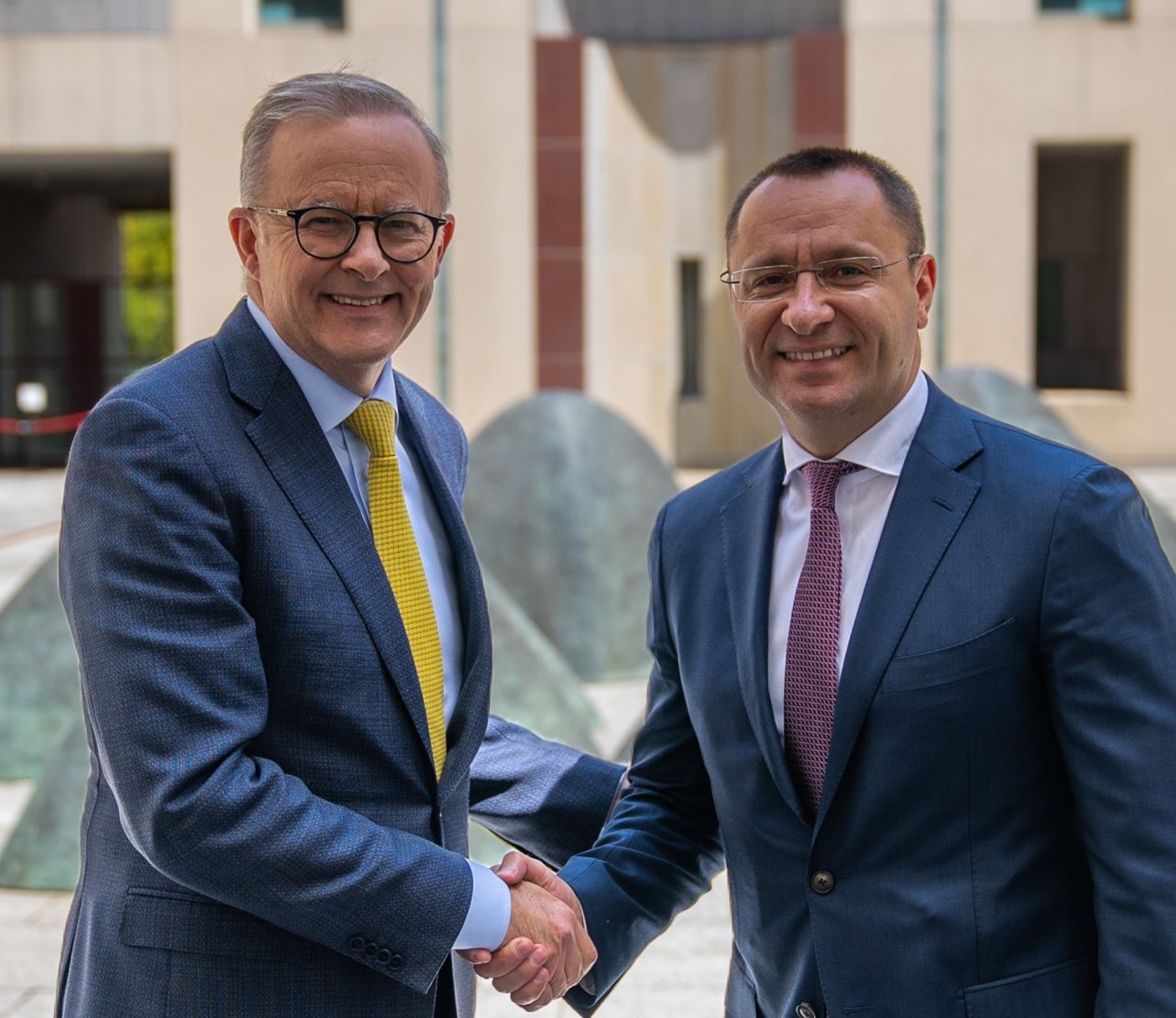
Ukraine’s Ambassador to Australia Vasyl Myroshnychenko (R) has called for public and foreign governments not to become blasé about or distracted from Ukraine’s plight. Photo: Vasyl Myroshnychenko LinkedIn.
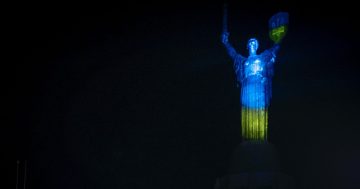
This week saw the fourth anniversary of Russia’s invasion of Ukraine, and the war continues to be bogged down in the mud of Donbas, as well as the political and diplomatic halls of the world.
Within one week of the start of the 2022 invasion, Russian troops had conducted a rapid advance that saw them in the outskirts of the Ukrainian capital of Kiev, and at that time not even the most optimistic observers thought Ukraine could hold out against such pressure.
But four years later, and not only has Ukraine endured, but it has actually taken territory back from those initial Russian gains, and has even conducted expeditionary raids into Russian territory around Kursk, and drone and missile strikes deep inside Russia.
To date, Ukraine’s survival has been very much enabled by a total mobilisation of its industry and population towards the war effort led by inspired leadership, the ongoing supply of weapons by Europe, the US, and other nations including Australia, and the rapid adoption and agility of innovative tactics and technologies.
And this is despite Ukraine’s sovereignty being assured by the 1994 Budapest Memorandum on Security Assurances which was signed by the US, France, the UK, China – and Russia – in exchange for Ukraine giving up nuclear weapons left over from the break-up of the Soviet Union, where not one soldier from those countries has officially come to Ukraine’s aid.
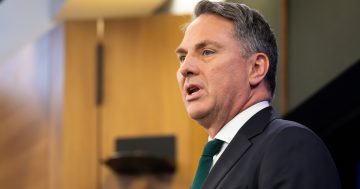
In recognition of the four-year anniversary, Australia has reiterated its support for Ukraine through a joint statement by Prime Minister Anthony Albanese, Foreign Minister Senator Penny Wong, and Defence Minister Richard Marles.
“Australia is steadfast in our commitment to a just and lasting peace for Ukraine,” it reads. “Since the outset of the invasion, Australia has made clear that Russia, and those enabling its illegal war of aggression, will face consequences.”
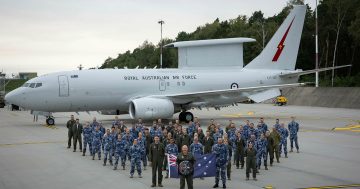
The statement said Australia had committed $1.7 billion in assistance to Ukraine, including $1.5 billion in military support in the form of mostly surplus or retired Australian Defence Force equipment.
Some of this equipment includes Bushmaster armoured vehicles, M113AS4 armoured personnel carriers, M1A1 main battle tanks, rigid hull inflatable boats (RHIB), Supacat special forces vehicles, M777 Howitzers, air defence and anti-armour missiles, and other equipment.
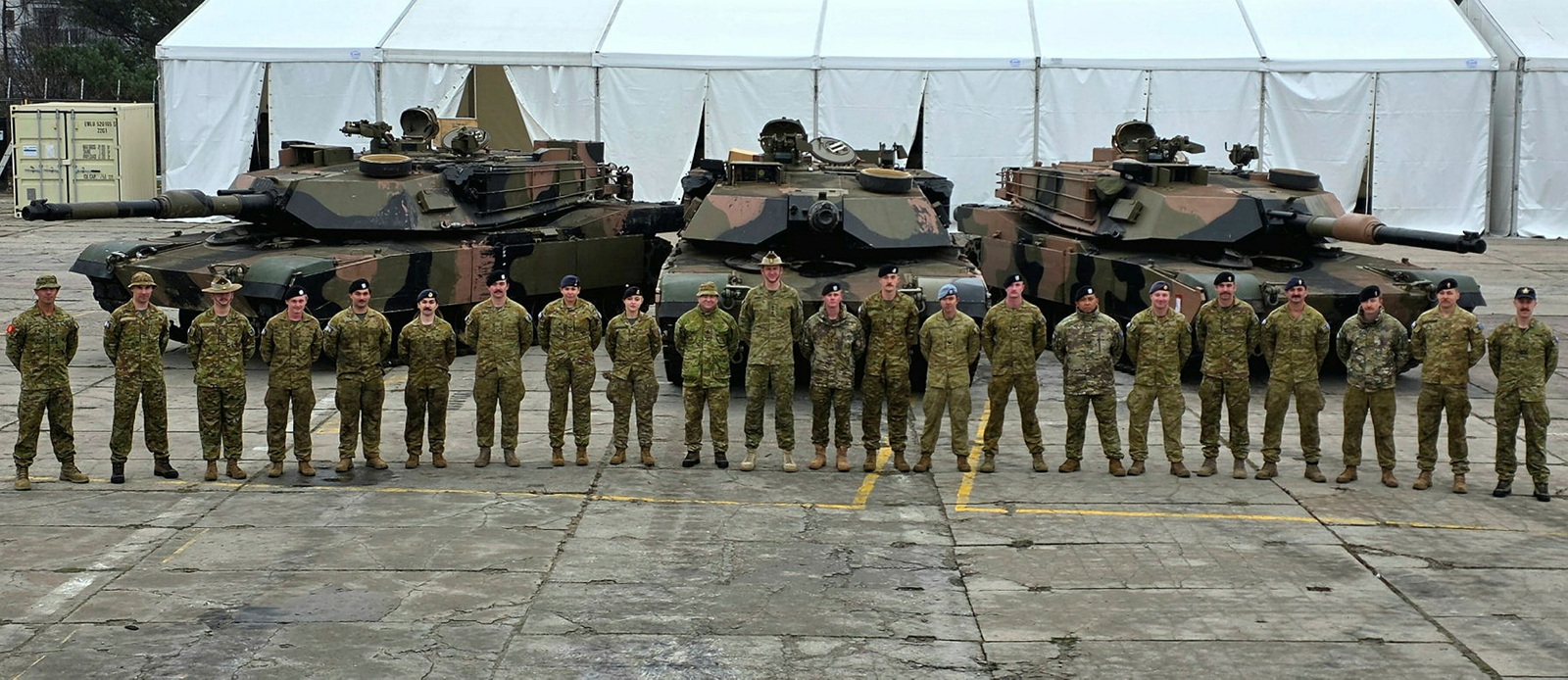
Former Australian Army M1A1 tanks in Poland being prepared for delivery to Ukraine. Photo: ADF.
Other countries have donated or sold Ukraine fighter jets, helicopters, tanks and armoured vehicles, air defence systems, vast amounts of ammunition, and training packages.
By all reports, Russia has sustained more than a million casualties either killed or wounded in the war, and has lost hundreds of aircraft and air defence systems, and thousands of armoured vehicles. But Russia has demonstrated in previous wars that it is prepared to absorb huge numbers of casualties, and that it has the industrial capacity to replace those equipment losses.
It has also forged pseudo-alliances with China and North Korea, both of which have supplied vast amounts of equipment and large numbers of artillery shells, while North Korea has even sent ground troops.
Many reports also suggest Ukraine has suffered a similar number of killed or wounded, with a higher proportion of those being civilians, and it remains to be seen how long these can be sustained.
Russia has also targeted Ukraine’s civilian infrastructure, in particular its energy grid during the harsh winter months on the steppe. In response, Australia has committed $40 million to the Ukraine Energy Support Fund, including an additional $10 million announced in January.
Australia has also announced a further round of sanctions on individuals and entities and shadow fleet vessels with links to Russia, in its largest single sanctions package since February 2022.
“These new sanctions target Russia’s finance and banking, defence, aeronautical, oil and gas, transportation, and science and technology sectors,” the statement reads. “They are designed to squeeze Russian revenues and further constrain its ability to continue its illegal and brutal invasion.”
In a 21 February op-ed in the Australian Financial Review, Ukraine’s Ambassador to Australia Vasyl Myroshnychenko said the public and foreign governments could become blasé or distracted over the course of a long war.
“Despite horrible news of death and destruction, desensitisation can set in and concern about the war can be diminished,” he wrote.
“Or, other bad news – in fact, other wars in other places – can supplant the original one in our headlines and in our attention spans.
“As we mark the fourth year since Russia’s full-scale invasion of Ukraine in February 2022, these phenomena can certainly apply here in Australia. Stories of Ukrainians spending winter in their flats without heat or light due to the Kremlin’s psychological bombing campaign register, but can somehow seem ‘normal’.
“And, this habituation to illegality, aggression and brutality is exactly what Vladimir Putin hopes for and calculates for,” he added.
“The more accustomed the world is to his despotic excesses, the more comfortable he becomes in committing them and the less he expects to face consequences for his malicious and imperialistic actions.
“As we reflect on the fourth year of the war, it is good therefore that there is good news on the side of good. Firstly, Putin’s narratives are patently false. Secondly, the Australian public and government know it and continue to proceed accordingly as strong allies of Ukraine.”