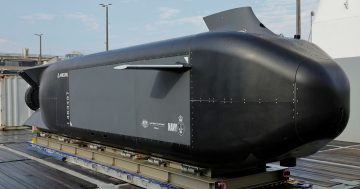
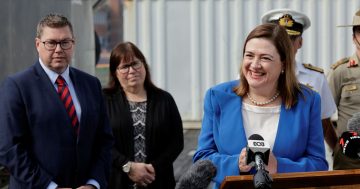
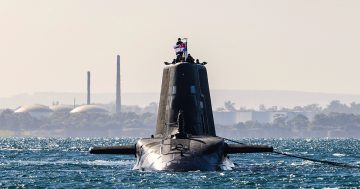
Chief Defence Scientist Professor Tanya Monro, CEO of Anduril Australia David Goodrich, Chief of Navy Vice-Admiral Matt Buckley, and Defence Industry Minister Pat Conroy stand in front of two Ghost Shark XLUUVs and new modular undersea payloads at Anduril’s Sydney facility. Photo: POIS Daniel Goodman, ADF.
A number of new undersea capabilities designed to be deployed from uncrewed submarines are being tested at a large maritime exercise underway in the US.
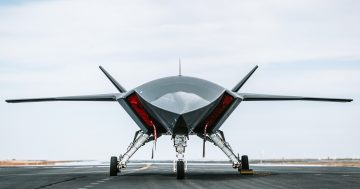
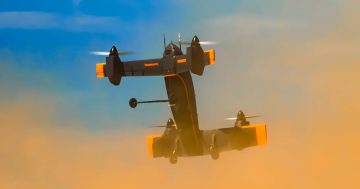
The capabilities were developed under the AUKUS Pillar II construct, and were revealed this week at Anduril Australia’s production facility in Sydney. They include sea mines, supply caches, and uncrewed aerial vehicles, all of which can be employed by the Ghost Shark and Speartooth uncrewed underwater vehicles (UUV), and BlueBottle uncrewed surface vessels (USV).
The advancement and design of the payloads and enabling systems has been a collaborative effort between the Royal Australian Navy (RAN), Defence Science and Technology Group (DSTG), Advanced Strategic Capabilities Accelerator (ASCA), and defence industry.
The Ghost Shark is under development for the RAN by Anduril Australia with input from the Defence Science and Technology Group (DSTG), with Defence signing a $1.7 billion deal with the company last year to supply “dozens” of the XLUUVs.
The eight-metre-long Speartooth has also been developed in Australia by Melbourne-based C2 Robotics, and has been tested in Western Australia by the RAN and the UK’s Royal Navy.
The BlueBottle is a solar and wind-powered surface vessel which was developed in Australia by Sydney-based Ocius, and is in service with the RAN and Royal New Zealand Navy on autonomous border security and intelligence, surveillance and reconnaissance missions.
AUKUS Pillar II is designed to promote the co-development by Australia, the UK, and the US of capabilities such as autonomous systems, quantum computing, hypersonics, space systems, undersea capabilities, and artificial intelligence.
All three of these autonomous systems have been designed to carry and employ modular payloads designed to enhance undersea warfare capabilities, seabed operations, sea denial and the protection of critical undersea infrastructure such as communications cables.
Exercise Maritime Big Play is a biannual exercise held off the coast of southern California, and is designed to test and develop next-generation maritime capabilities in a tactical setting. Attendees include military and defence industry personnel from the three AUKUS countries, and has also included Japanese personnel in past iterations.
Defence Minister Richard Marles said the government was committed to delivering practical outcomes that strengthen Australia’s defence capability while building its sovereign defence industry.
“The development of advanced, cutting‑edge payloads under AUKUS Pillar II is a critical part of our work alongside the United States and the United Kingdom,” he said.
“Australia will again have the opportunity to showcase its sovereign developments at Exercise Maritime Big Play Pacific, and our work behind the scenes means we can be more open about our work to deliver these important technologies.”
Minister for Defence Industry Pat Conroy added, “Ghost Shark is a flagship Australian success story that showcases the ingenuity of our defence industry and the value of investing in sovereign capability.
“Our government opened this factory less than a year ago and Ghost Sharks capable of a range of complex missions operating far from our shores are now rolling off the line at an increasing rate into the hands of the Australian Navy.
“This announcement is yet another landmark moment that underscores Australia is a world leader in the development of autonomous undersea capabilities. It also underscores the government’s commitment to supporting our sovereign defence industry and a future made in Australia.
“Today we’re revealing to the world that the Ghost Shark will have a capability to deploy sea mines,” Mr Conroy added.
“It will have the ability to deploy logistical caches, so think of compartments containing equipment produced by the DSTG.
“And thirdly, the Ghost Shark will have the capability to deploy the ALTIUS uncrewed aerial vehicle [which] will have the ability to do intelligence, surveillance and reconnaissance, but also to do strike.”
Defence Chief Scientist Professor Tanya Monro said that while Ghost Shark was an extraordinary platform, the announcement was more about what that platform could do.
“Capability comes from payloads, and that’s what turns a vehicle into a mission system, and they’re what allows us to adapt as operational needs evolve,” she said.
“Defence Science Technology Group is proud to have played a major role in that effort. For example, our scientists and engineers developed the logistics cache payload from concept through to integration, enabling equipment and supplies to be stored beneath the surface and recovered when required.
“We worked closely with our navy and with our industry partners to deliver this capability at pace,” she added. “Using a modular approach, we can evolve that capability as the needs change without having to redesign the entire system.”