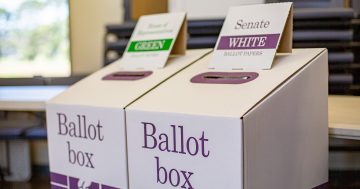
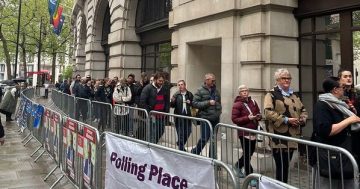
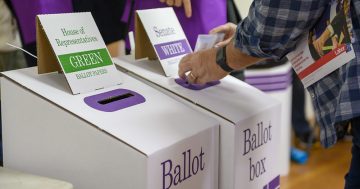
The AEC has announced a redistribution of election boundaries in the ACT. Photo: AEC
Federal electoral boundaries in the ACT are set to change for the next election, following the Australian Electoral Commission’s redistribution decisions, announced on Wednesday (8 July).
The territory’s three federal electorates of Bean, Canberra and Fenner will all retain their names.
The suburbs of Hughes, Curtin, Garran and Lyons will move from the central electorate of Canberra to the southern electorate of Bean, uniting the Woden Valley into a single electorate.
The Molonglo Valley and the suburbs of Hume and Symonston will move the other way – from Bean into the electorate of Canberra.
The electorate of Fenner will remain essentially unchanged, despite earlier proposed boundary changes.
Fenner will have a minor alignment to the boundary at the intersection of the Barton Highway and Gundaroo Drive, but this will involve no movement of electors.
The AEC rejected redistribution proposals flagged in May that would have seen Fenner lose the suburbs of Crace, Kenny and Mitchell to Canberra, while gaining Weetangera, Hawker and Macquarie in Belconnen.
A proposal to move Norfolk Island and part of the suburb of Duffy from the electorate of Bean to Canberra was also rejected.
Norfolk Island will therefore be retained in the electorate of Bean.
The AEC’s Augmented Commission for the ACT did not agree with these proposed changes, which Electoral Commissioner Jeff Pope said demonstrated the value of having multiple layers of submissions, comments and governance in the process, with the final boundaries coming after extensive community consultation.
An augmented electoral commission is a specific statutory body established by the AEC to determine the final boundaries and names of federal electoral divisions during a redistribution.
“We are very grateful for the time and effort members of the public went to in making their submissions, which really helped inform and shape this important outcome for the ACT,” Mr Pope said.
“The changes made to the original proposal published in March were a result of public input, including how electorate boundaries could best reflect local communities.”
The redistribution for the ACT was necessary because the territory’s last redistribution occurred in 2018, and electoral laws require a redistribution at least every seven years.
The augmented electoral commission was required to consider all submissions made to it under the Commonwealth Electoral Act 1918 (Electoral Act) concerning the proposed redistribution for the Australian Capital Territory.
It was also required by the Electoral Act to meet the numerical requirements of section 73(4)
Those requirements include that the number of electors in each electoral division “shall, as far as practicable, not deviate from the projected enrolment quota of 114,842” at the projection time of 8 April 2030 by more than plus or minus 3.5 per cent.
The number of electors enrolled in each electoral division in the ACT at the time of the projection therefore had to be between 110,823 and 118,861.
Another requirement is that the number of electors in each electoral division “shall not deviate from the redistribution quota of 107,293” by more than plus or minus 10 per cent.
The number of electors enrolled in each electoral division in the ACT must therefore be between 96,564 and 118,022.
In relation to each electoral division, the AEC was also required to give due consideration to the community of interests, including economic, social and regional interests; means of communication and travel; physical features and area; and existing boundaries.
Maps for the new electorate boundaries will be released when the redistribution is formally determined on 8 October 2026, and a final report will be available after it has been tabled in Federal Parliament.
The outcomes of the redistribution do not take effect until the next general election after that date, meaning they will be in place by the next federal election, due by May 2028.
The reasons for the augmented electoral commission’s determination of the redistribution will be detailed in its report, due to be published later this year.
Original Article published by Chris Johnson on Region Canberra.