
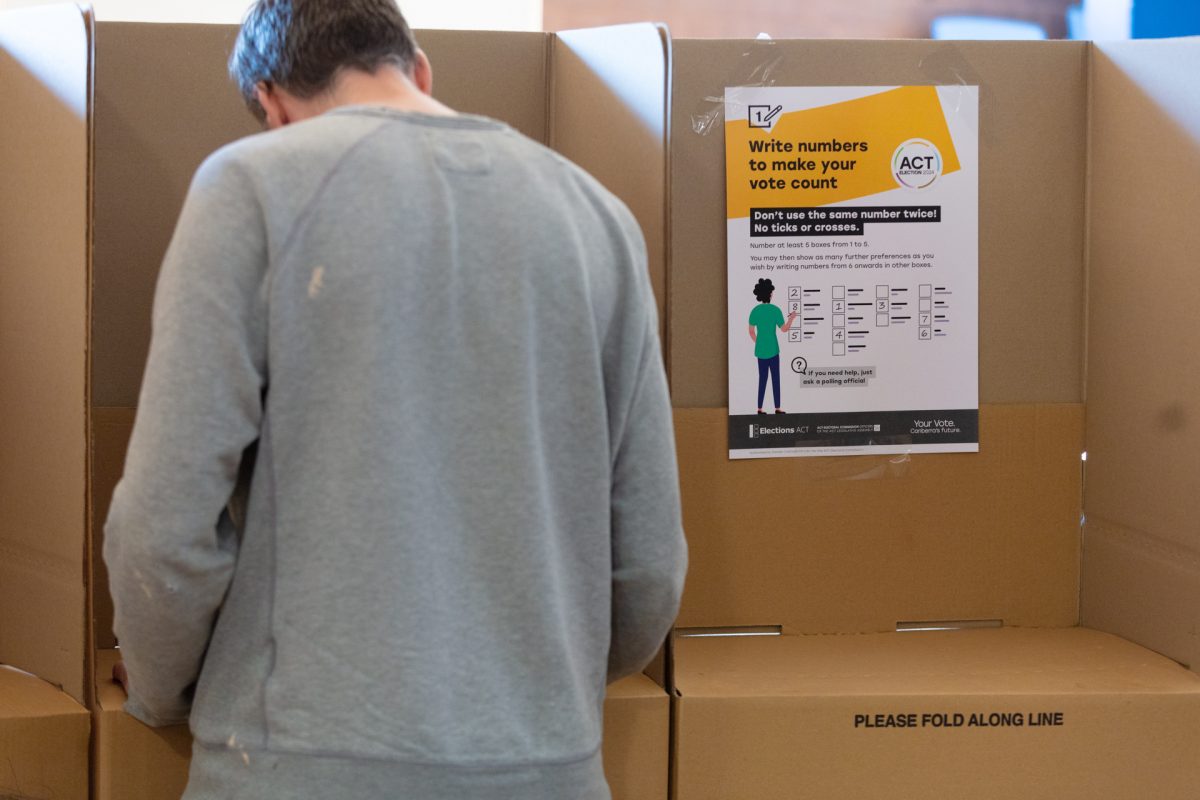
It’s feared deepfakes could be used to spread misinformation during elections. Photo: Michelle Kroll.
The ACT has a “watching brief” on how AI deepfakes could impact the lead-up to elections, but doesn’t plan to jump the gun on legislative change just yet.
An inquiry into the operation of the 2024 ACT Election and Electoral Act 1992 heard from several parties about how the acceleration of AI technologies needed to be taken into account before Canberrans next cast their vote in 2028.
Deepfakes are artificial images or videos often created to be deceptive and are a growing tool for misinformation and digital impersonation.
The ACT Electoral Commission has previously called for new laws to keep pace with technological advances, stating that if concerns about the use of AI during the last election had been raised, it would have had no recourse.
ANU Law Reform and Social Justice Research Hub student researcher Ethan Zhu didn’t have a definition answer on what the Territory should do, but wasn’t in support of banning the use of the technology during elections entirely.
“I think it would be an error to ban the use of generative AI [during elections] completely,” he told the inquiry hearing.
“There are a lot of benefits that this technology can provide to our democracy and our political system.”
Mr Zhu said there was also a “genuine place” for parody and satire in the campaigning space.
“However, undoubtedly action does need to be taken, in that this is a relatively new technology that can make it literally indiscernible to tell what is real and what is not,” he said.
“It is very likely that it wouldn’t be possible to disprove or debunk these deepfakes until after the election, when the damage is already done.”
Attorney-General Tara Cheyne said the ACT Government’s stance on whether to ban AI from elections entirely, require candidates or parties to disclose its use, and address consent issues still hadn’t been decided.
“I think AI, as a supportive tool, is worth exploring. But AI, when it’s used to spread misinformation or otherwise undermine democracy, that’s really significant,” she said.
“[But] the opportunities it can afford are not all benevolent”.
But she added the ACT Government had a “watching brief” on how it would be used in elections being held before 2028.
“We always say legislation, it isn’t static, it needs to evolve and reflect societal attitudes at the time,” Ms Cheyne said.
“I think the evolution of AI, and the speed at which that’s occurring … is potentially quite ahead already of where governments and parliaments are at.
“Even [if we change] legislation at a point in time, [it] could quickly be out of date.”
The South Australian government recently passed laws banning deepfake political advertisements ahead of its state election in March 2026.
It means the use of AI-generated deepfakes to make electoral ads showing acts a person didn’t perform – without that person’s permission – will be banned. Penalties of up to $5000 can apply.
Any political advertisements that use AI must be clearly labelled.
ANU PhD researcher and inquiry witness Mark Fletcher had a potential solution to the issue of legislation becoming outdated, telling the hearing that AI specifically didn’t need to be targeted in legislation, given the existence of Photoshop, trick photography, look-alikes and voice mimics – the latter used by the Canberra Liberals during the October 2024 Territory election.
He instead argued that a legislative change could be made to address the underlying reasons for the use of ever-evolving technologies, rather than the technology itself.
“[You] can play whack-a-mole with all of these things forever, or we could take a principled approach right back at the start and say: what actually is the fundamental mischief that we’re trying to deal with?” he said.
“[If addressed] then it doesn’t matter if AI-conduct is the sort of thing that we refer to the Integrity Commissioner after the election’s finished.”
The reporting date for the inquiry has yet to be confirmed.
Original Article published by Claire Fenwicke on Region Canberra.