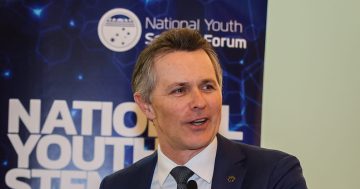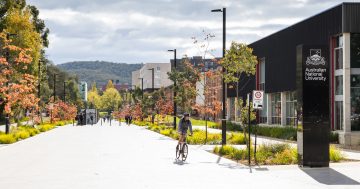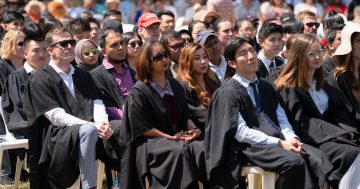

University enrolments across Australia have reached a record high this year. Photo: Michelle Kroll.
First-year university enrolments are up, reaching a record high this year thanks to jumps in students studying social work, engineering, science, teaching and nursing.
Preliminary data from the federal Department of Education, released on Monday (16 February), show university applications for commencing undergraduate students are up 4.6 per cent and offers are up 2.5 per cent compared to the same time last year.
Teaching and nursing enrolments are both up 6 per cent; science is up 8 per cent; engineering is up 9 per cent; and social work enrolments are up a whopping 19 per cent.
This follows the Australian Tertiary Education Commission allocating an extra 9500 domestic places to universities this year on top of 2025 levels.
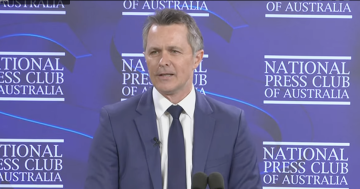
Education Minister Jason Clare said more Australians will start a university degree in 2026 than in any previous year.
“It’s happening because we’re investing more in universities to enable people to do those courses,” he said.
“We’re creating more places at uni, and it’s great to see them being taken up. This means more Australians will attend university this year than ever before.
“The Universities Accord says that by 2050, 80 per cent of the workforce will need a tertiary qualification.
“The only way to hit that target is to help more people go to university and TAFE. This will help more people build the skills they need for the jobs of the future.”
The Universities Accord was established to expand access to university education and aims for 80 per cent of the workforce to hold a tertiary qualification by 2050.
That would be up from about 60 per cent today.
Mr Clare said the only way to hit that target is to help more people access university and TAFE, and that includes making more university places available.
He said a further 16,000 fully funded Commonwealth-supported places will be allocated in 2027.
“Over the next decade, we expect to fund another 200,000 commencing places at university,” the minister said.
“This is all about opening the doors of our universities wider and helping more people build the skills they need.”
The increased costs for degrees in humanities, which the Morrison government introduced under the Jobs Ready Graduates scheme, have likely contributed to the rise in enrolments in other (cheaper) areas of tertiary study.
Mr Clare described that initiative as a failed scheme and said the government was currently working on changes to it.
Legislation establishing a new commission to develop a funding model for universities is still before the Federal Parliament.
A recommendation of the Australian Universities Accord, the Australian Tertiary Education Commission (ATEC) will aim to drive long-term reform across the tertiary education system.
It will promote a joined-up tertiary system between VET and higher education; allocate funding under the new managed growth funding system; implement needs-based funding within the core funding model; and negotiate mission-based compacts to support the sector.
The ATEC is currently operating in an interim capacity and, subject to the passage of legislation, will be fully operational later this year.
The ATEC legislation passed the House of Representatives on 10 February, and Mr Clare said he was hopeful it would pass through the Upper House when parliament returns in March.
“The Senate committee is looking at that legislation right now. We’re expecting its report at the end of the week,” he said
The minister would not be drawn on whether this year’s federal budget will include further student debt relief.
Labor’s recent budget initiatives have resulted in more than three million Australian students having their student debt cut by 20 per cent, totalling almost $16 billion.
Original Article published by Chris Johnson on Region Canberra.