

The Federal Government wants Australians to own AI tools and is prepared to help make it happen through public policy and private investment. Photo: File.
The Federal Government wants artificial intelligence tools to be owned by Australia and is prepared for the nation to substantially buy into the multi-trillion dollar economy, largely through private sector investment, in order to keep the technology in the country.
The overall sentiment inside Labor is that if Australians owned a big enough share of AI tools, their jobs would be higher paying, more secure and contributing to the national wealth.
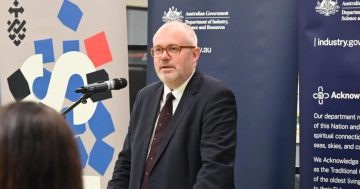
Assistant Technology Minister Andrew Charlton delivered a pointed address to the Australian Business Economic Committee on Tuesday (24 February) insisting AI needed to be owned by Australians.
“Now let’s say as a thought experiment Australia lifts its share of the global AI economy by 0.5 per cent heading into 2030. What might that mean for our prosperity?” he said.
“This would imply an additional $25 billion per annum relative to our baseline performance.
“This means hundreds of thousands of new high-value jobs, productivity spillovers, higher taxation bases and a greater depth of talent that will create more prosperity for Australia.
“To give Australia the best chance of success, we need public policy and private investment working together, directed toward the parts of the AI ecosystem where our strengths are real and our returns are likely to be highest.”
Dr Charlton said the government was prepared to make Australian ownership of AI a reality so as to keep from remaining offshore. Currently, Australia only has a 0.18 per cent global share of all AI patents.
But with access to 4.8 billion people in the Asia-Pacific, Australia could be a launching pad for AI in the whole region, he said.
“If the tools are owned elsewhere and we simply rent them, the dividends flow offshore,” Dr Charlton said.
“Productivity may rise, but national income does not necessarily follow. We will gain some benefits from adoption, but relative to other countries we may fall behind …
“We must build it here, back Australian founders, equip Australian workers and ensure that AI is something we design, deploy and lead, not something we merely import and consume.”
Declaring AI to be the “next great general-purpose technology”, the assistant minister said the world was still discovering its possibilities.
But its direction is clear – AI converts data, water and energy into intelligence and with it, the capacity to solve problems at scale.
He said the question was not whether AI would change the economy, because it would, but how to maximise the benefits to Australia and its people.
A lazy approach to AI, he said, would lead to a continued “Uberisation” of the nation’s economy and a future where Australians rented the platforms, imported the intelligence and exported the profits.
“The forecasts for AI could not be further apart,” Dr Charlton said
“At one end is sweeping optimism: productivity surges, incomes climb and people are freed from drudgery to focus on creativity, care and higher pursuits.
“At the other is deep pessimism: wealth concentrates, inequality widens, jobs are displaced faster than they are created and democratic institutions strain under the weight of technological power.
“Between those poles lies the real task of policy …
“There is a deeper lever we must keep in view … who owns the technology? Ownership and access – more than in any previous wave – will heavily shape how gains are captured and with whom they will be shared.
“That is why Australia’s approach must be pro-adoption and pro-creation.”
The government released its national AI plan late last year, outlining a pathway to investment and training in the fast emerging technology.
The plan dumped plans for 10 mandatory guardrails intended to govern the further development and uptake of artificial intelligence in Australia.
The National AI Plan has three goals: capturing opportunities, including attracting investment in Australia’s digital and physical infrastructure; spreading the benefits of AI by improving public services, supporting AI adoption and building skills across the economy; and keeping Australians safe.
Original Article published by Chris Johnson on Region Canberra.