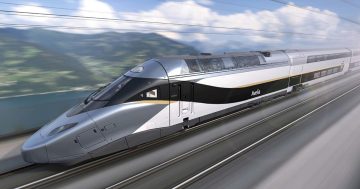

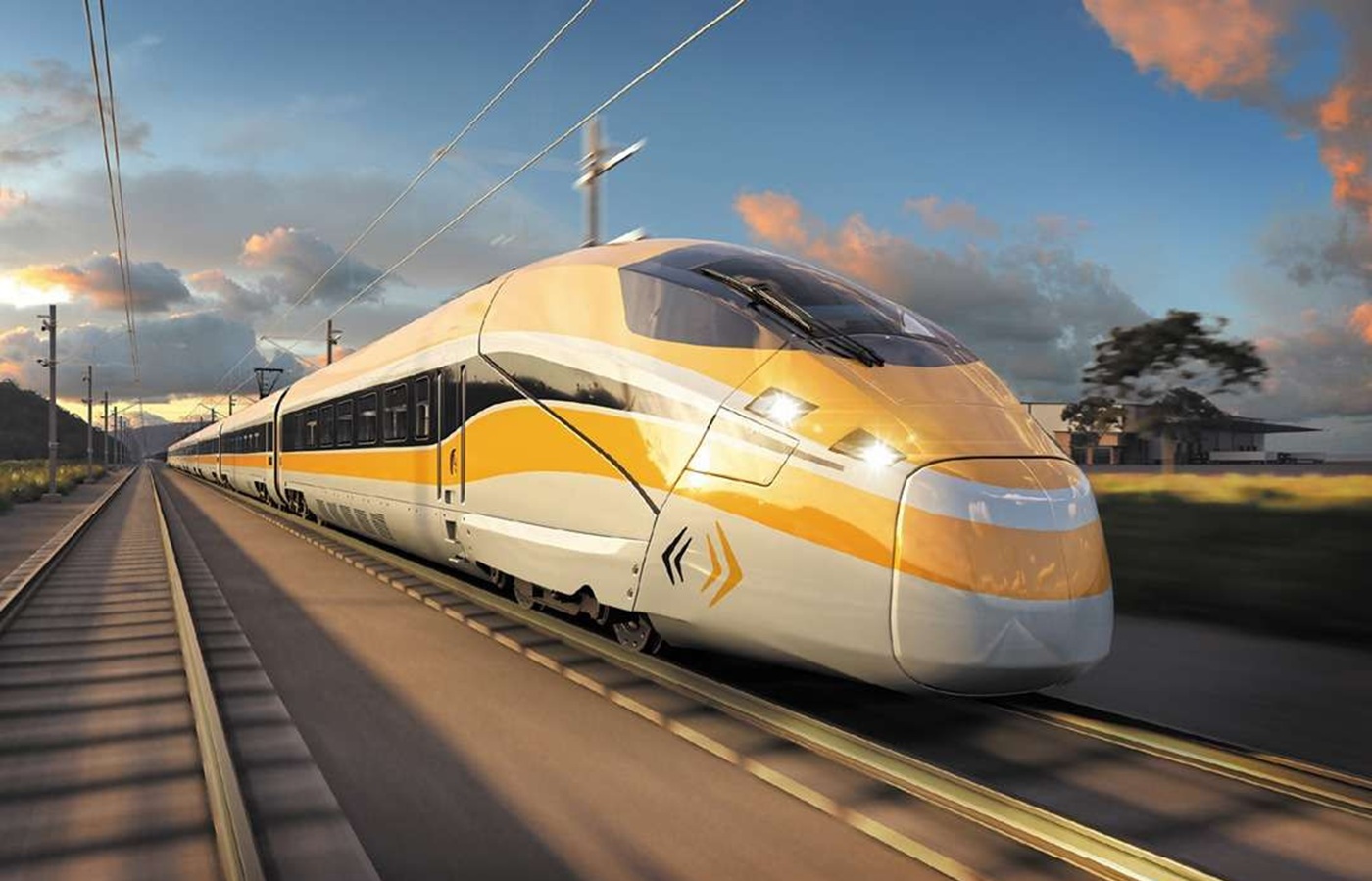
The trains will be 200 metres long and capable of travelling at up to 32o km/h. Image: HSRA.
The federal government has announced it will proceed with the next stage of development of a possible high-speed rail corridor along Australia’s east coast, with the first phase planned to run between Sydney and Newcastle.
The $230 million development phase, as outlined in the High Speed Rail Authority (HSRA) business case, is scheduled to run for 2 years and is designed to ensure the planned line between the two cities is ready for construction in 2029.
The development phase is the detailed work required to lock in the design, approvals process, scope, and costs prior to awarding major construction contracts.
If it proceeds, the Phase 1A line is projected to cost about $55 billion, including station infrastructure and rolling stock, and could be operating as early as 2038. Travel times will be cut from the current two-and-a-half hours to about one hour on the 140 km line between Newcastle and Sydney, and from 75 minutes to 30 minutes on the Central Coast line between Gosford and Sydney.
Trains will terminate at Sydney Central and at Broadmeadow in Newcastle, with an additional line planned to run at the Sydney end from Central to the new Western Sydney International Airport via Parramatta.
Despite the upfront cost – which some had predicted could run as high as $90 billion – the project’s business case has assessed that it will generate some $250 billion for the Australian economy and produce 99,000 jobs over the next 50 years, with the construction, advanced manufacturing and tourism sectors all likely to benefit.
Minister for Infrastructure, Transport, Regional Development and Local Government Catherine King said high-speed rail between Newcastle and Sydney will change the way people live, work and travel in Australia’s most populous region.
“It will connect the Newcastle and Central Coast communities to Sydney in a way that has never been done before,” she said.
“The Albanese Government is focused on delivery. This development phase will lay the foundations for the delivery of high-speed rail between Newcastle and Sydney, ensuring we secure the rail corridor and undertake detailed planning before we start building.
“Carefully planned, costed and detailed preparation takes time, but it means when construction starts, it is built to last,” she added.
The minister added that the Federal Government is unlikely to be able to fund the project itself, and that a mix of private and public financing options will also be assessed.
“What we’re doing now is going into a two-year development phase. Basically, engineers will be going metre by metre along this rail track and designing it, designing all the tunnels, designing the stations, getting it ready for a final investment decision in 2028 for the Commonwealth to decide what the next steps are,” she told ABC Radio Newcastle on Tuesday morning (24 February).
“Normally, you sort of get to a business case, and then you make an investment decision. What we want to do is get a lot of surety about exactly what the design is going to be.”
The HSRA anticipates adult fares between Sydney and Newcastle to cost about $31 in 2025 dollars, compared to $22 on the current XPT service and $10 on Sydney Trains.
Phase 1A is expected to comprise 194 km of new fully dedicated high-speed rail alignment, including twin-bore tunnel sections totalling 115 km, 30 km of bridges and viaducts, and 41 km of surface alignment. Almost all of the line from Gosford to Central and on to Parramatta will run underground, while a stabling and train facility will be established at the northern end of the Central Coast.
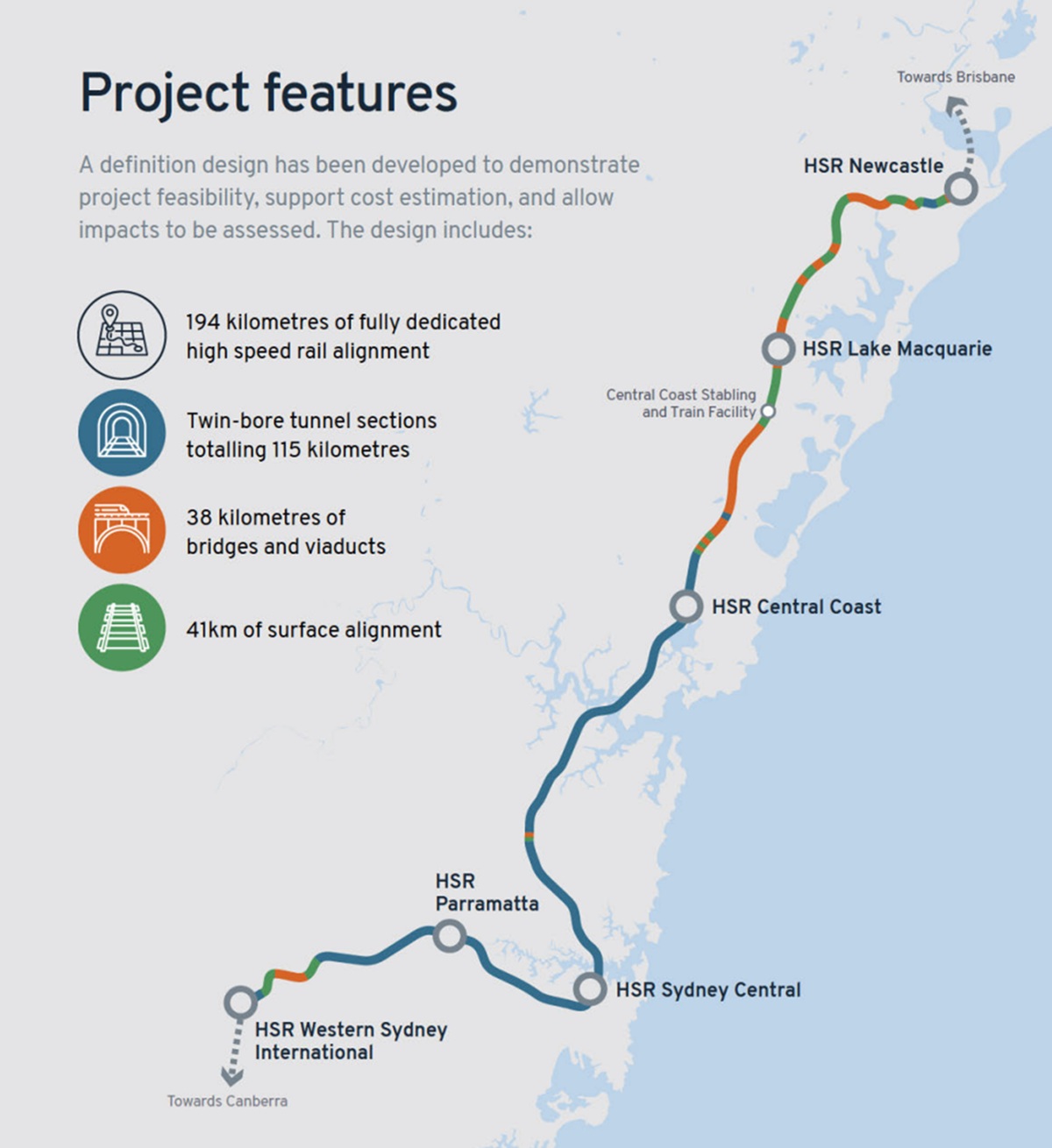
The HSR alignment between Newcastle and Sydney follows the current track. Image: HSRA.
The trains themselves will be about 200 metres long and capable of travelling up to 320 km/h, although tunnel sections will be limited to 200 km/h.
The exact alignment of the proposed line is not included in the HSRA document, but it follows the current rail line’s alignment between the cities.
But Minister King says the alignment is “pretty locked in”.
“People would have seen High Speed Rail Authority people drilling and having a bit of a look at what’s along the route … so the route’s fairly set,” she told ABC Radio.
“But of course, in the development phase, if they find there’s something that’s impossible to get through, or it’s going to add to the cost hugely, you know, it might deviate slightly.”
The Rail, Tram and Bus Union (RTBU) welcomed the announcement, saying the investment will reshape transport and strengthen regional communities.
“This is a significant step forward, and we commend the government for recognising rail as the transport option of the future,” RTBU National Secretary Alex Claassens said.
“For too long, our transport network has lacked the long-term investment and vision required to keep pace with the growing needs of Australians. High-speed rail represents a shift in direction, away from reliance on the airline industry and private vehicles, with the potential to reshape how we move and how our regions grow.”
Professor Chris Pettit, director of UNSW’s City Futures Research Centre, said high-speed rail represents the logical backbone infrastructure for southeast Australia’s emerging urban growth corridor, linking Brisbane, Sydney, Canberra and Melbourne.
“As a nation-shaping investment, it has the capacity to unlock the economic and housing potential of key regional centres including Newcastle, Albury-Wodonga and Shepparton,” Professor Pettit said.
“International experience demonstrates how value capture mechanisms can play a central role in funding high-speed rail infrastructure. The Sydney-Newcastle corridor presents a strategically sound first stage in delivering this nationally significant project.”
But for residents in the Illawarra, Southern Highlands, Canberra, Riverina and rural Victorian regions, there is little detail yet on any future ambitions to extend the link south of Sydney as far as Melbourne, or north to Brisbane.
The business case released by the HSRA covers only the Phase 1A and 1B line between Newcastle and Sydney, and mentions only that an initial future phase will link Melbourne with regional Victoria, with a further phase to link the Sydney and Melbourne lines through Canberra.
In the longer term, a graphic in the document shows that a future high-speed rail line between Brisbane and southeast Queensland/Northern NSW would subsequently link to the Newcastle end of the line.