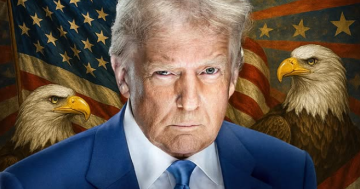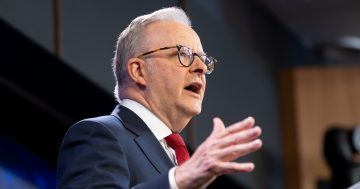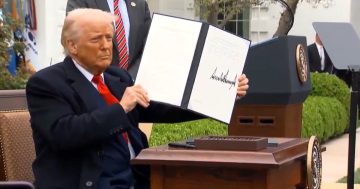

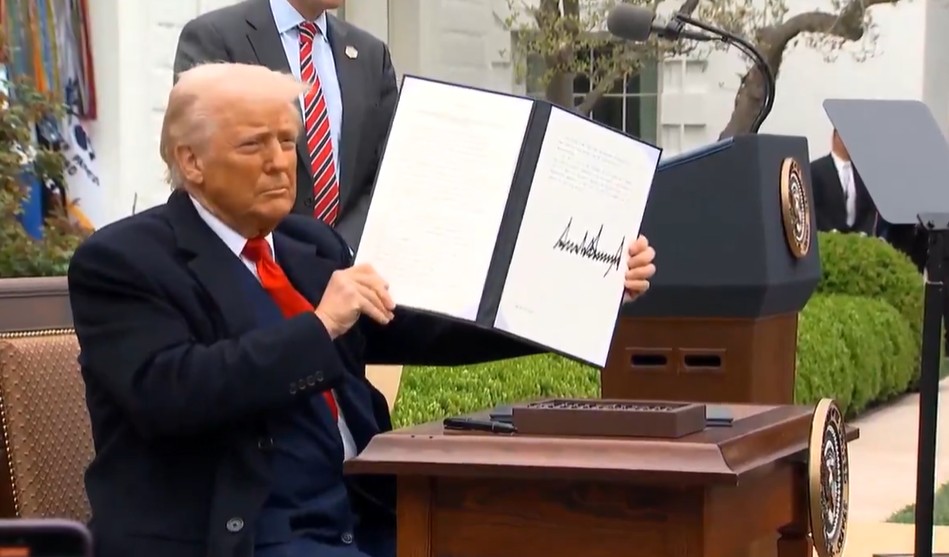
The US Supreme Court has ruled that Donald Trump’s so-called Liberation Day tariffs are illegal. Photo: Screenshot.
Australian officials are scrambling to make sense of Donald Trump’s latest tariff attack, following the US President’s snap decision to impose a 15 per cent tariff on imports from all countries.
Last week, Mr Trump announced the across-the-board 15 per cent tariff less than 24 hours after the US Supreme Court overturned his earlier so-called Liberation Day 10 per cent global tariff regime.
The court ruled 6 to 3 that those initial tariffs were illegal because there was no justification for invoking the emergency law that the Administration had cited to introduce them.
It is the first time the US court has overruled a Trump policy during his second term.
The President immediately retaliated by saying he would use a different trade law to reinstate the 10 per cent tariff.
But then Mr Trump went further, raising the universal tariff to 15 per cent.
“During the next short number of months, the Trump Administration will determine and issue the new and legally permissible Tariffs, which will continue our extraordinarily successful process of Making America Great Again – GREATER THAN EVER BEFORE!!!” he wrote on social media while denouncing the Supreme Court’s ruling as “ridiculous, poorly written, and extraordinarily anti-American”.
While the President insists that countries have been “ripping the US off for decades”, the Australian Government is on a mission to understand how the new tariffs will affect this country. They are expected to take effect from Tuesday (24 February).
Trade Minister Don Farrell, who is heading to the US this week for the G’Day USA event in Los Angeles, issued an immediate, but brief, statement to say the government was examining the latest Trump announcement.
Working with DFAT and Australia’s embassy in Washington, Senator Farrell said the government will continue its push to have the tariffs removed.
“Australia believes in free and fair trade,” Senator Farrell said.
“We have consistently advocated against these unjustified tariffs.
“We are working closely with our embassy in Washington to assess the implications and examine all options.”
The Federal Opposition wants the government to go hard against the US tariffs, with shadow trade minister Kevin Hogan urging Senator Farrell to make the most of his trip this week.
“This is bad policy, and we don’t want to see global retaliation,” Mr Hogan said during a Sky News interview.
“If I was Don, I would be saying very directly that this is not in the spirit of the free trade agreement.
“I think that needs to be put quite harshly to them.
“Just because you’re the biggest guy on the block doesn’t mean you use trade as a bullying tactic or as pressure points.
“It’s not in the spirit of the World Trade Organisation and the agreements we have. And that needs to be made really forcefully.”
Shadow defence minister James Paterson said the government must seek an exemption for Australia.
“I would hope that the President would consider an exemption for Australia from that tariff, and I hope that the Albanese Government, with their new ambassador, Greg Moriarty, shortly to start in Washington DC, are able to secure that exemption for Australia,” he said.
Greens Senator David Shoebridge went further, insisting the move proves America is no friend to Australia.
“Trump just jacked up tariffs against Australia by 50 per cent (from 10 to 15 per cent) as a late night reflex action to the Supreme Court decision,” Senator Shoebridge wrote on X.
“We matter so little in his world view. Can we stop pretending now: not a friend, not an ally.”
Meanwhile, the US’s top trade negotiator, Jamieson Greer, insists nothing has changed at all.
He told US television that while the Administration might have to use a different law to impose the global tariffs, it is still business as usual.
“The reality is, we want to maintain the policy we have, have as much continuity as possible, make sure that business understands this is the direction we’ve been going,” he said.
“We’re going to continue going this way … the policy hasn’t changed.
“The legal tools that implement that may change, but the policy hasn’t changed.”
Original Article published by Chris Johnson on Region Canberra.