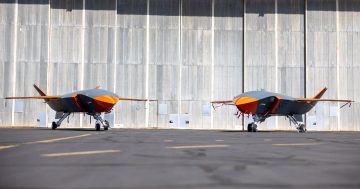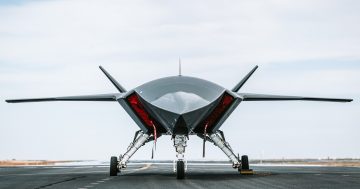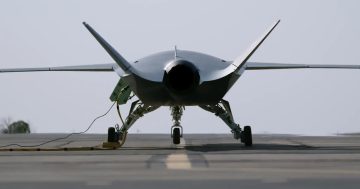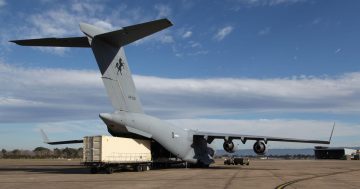

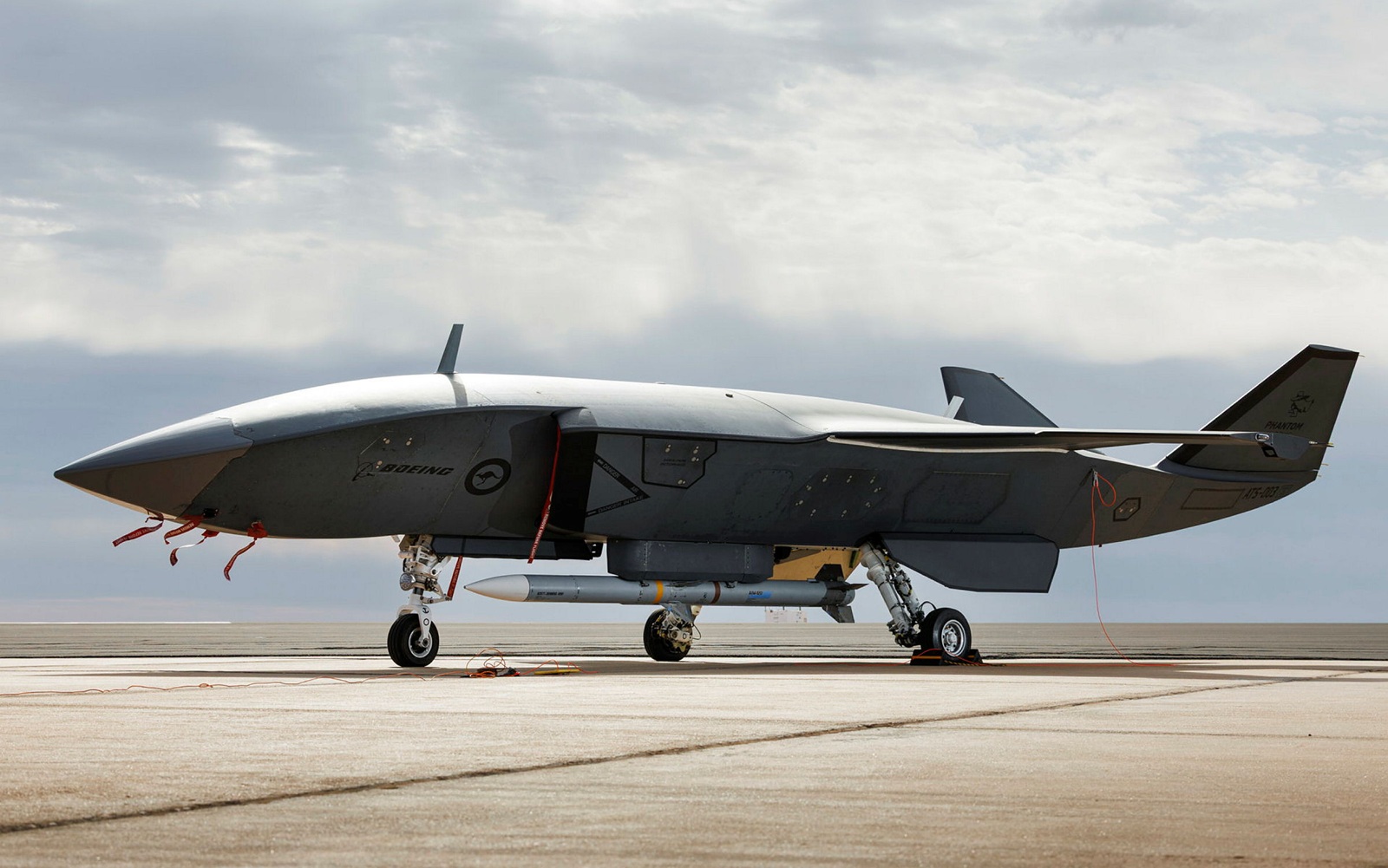
An MQ-28 sits on a ramp at Woomera in South Australia shortly before its successful first shoot-down of a target drone. Photo: ADF.
Boeing has given some new insights into the growth path of its Australian-developed MQ-28 Ghost Shark uncrewed collaborative combat aircraft (CCA).
Speaking to media at the recent Singapore Airshow, Boeing’s Ghost Shark program manager Glen Ferguson said the company was developing a larger and more capable version of the jet.
The insights come just weeks after the Australian Government confirmed the Ghost Shark had moved from a developmental program to production, with a $1.4 billion investment from the Commonwealth to advance the system’s development and to bring it up to an operational capability.
The funding announcement followed a successful operational evaluation of the MQ-28 which saw it deploy to RAAF Tindal in the Northern Territory, operate in conjunction with an E-7A Wedgetail airborne command and control aircraft, and complete a successful air-to-air missile shot against a target using an AIM-120 AMRAAM missile.
The announcement included funding for additional Block 2 MQ-28A air vehicles, and for development of a larger Block 3 variant.
The Ghost Bat was derived from Boeing Phantom Works’ Australian division’s Airpower Teaming System (ATS), a small fighter-sized autonomous aircraft which was intended to operate in conjunction with larger manned aircraft in a protective role as a ‘loyal wingman’.
The ATS was unveiled at the 2019 Avalon Air Show, where it was announced that an initial three prototypes had been ordered.
The ATS was initially designed to carry payloads such as optical, radar, or electronic sensors that would augment those capabilities carried by crewed systems such as the P-8A Poseidon or E-7A Wedgetail.
Following a successful first flight of an ATS at Woomera in February 2021, additional Loyal Wingmen air vehicles were produced to take the total of Block 1 aircraft to eight.
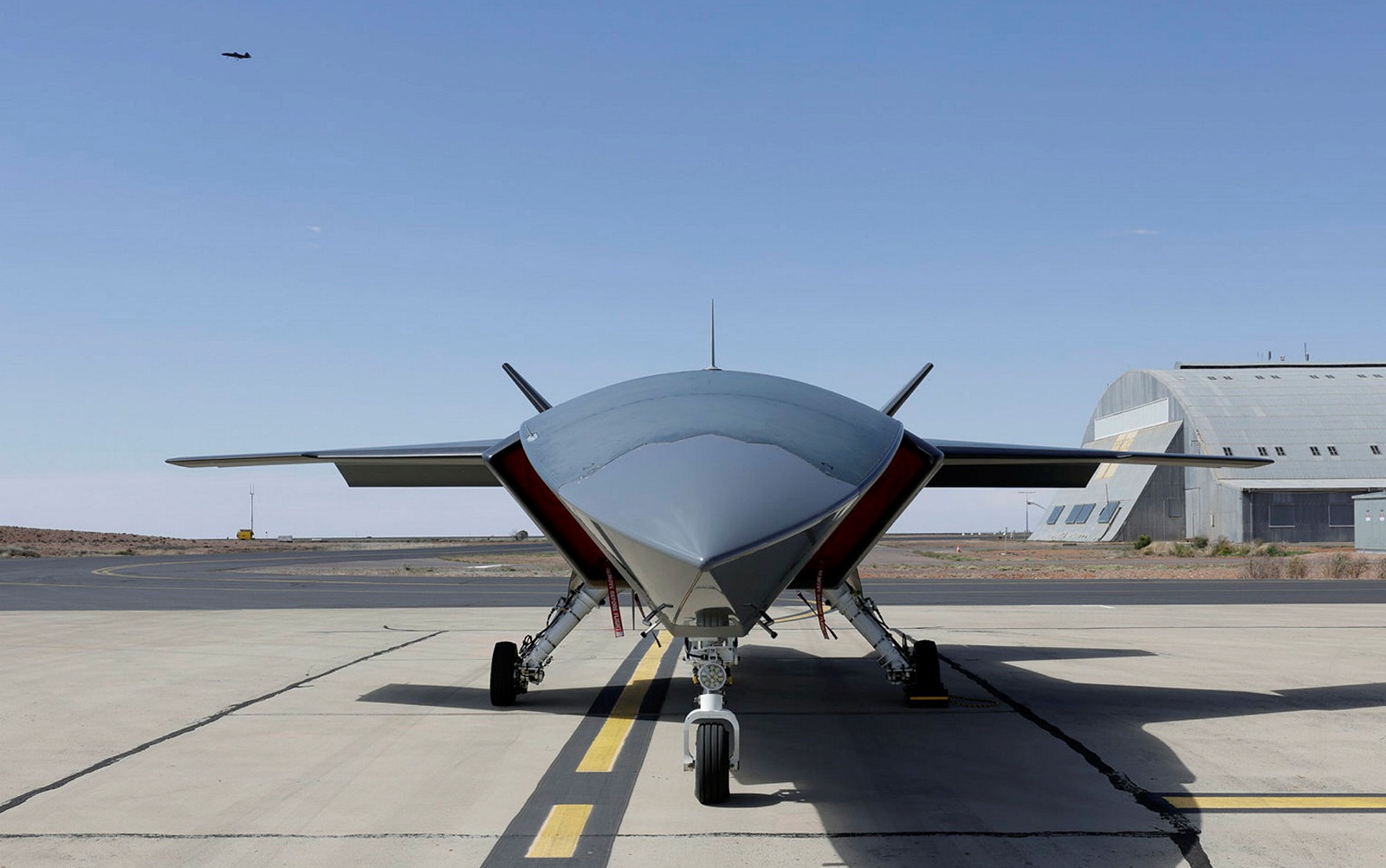
Block 3 Ghost Bats will have a longer wingspan with greater fuel capacity, and an internal payload bay. Photo: ADF.
In an official naming ceremony at RAAF Base Amberley in March 2022, the system was given the MQ-28A Ghost Bat name and designation.
During its early development, the potential of the Ghost Bat saw it evolve into that of a CCA, with confirmation that future MQ-28s will be capable of being armed with air-to-air and air-to-surface weapons.
As a part of the government’s 2023 Defence Strategic Review (DSR), the Commonwealth signed a CCA development project arrangement with the US Air Force, and it has been reported that two Ghost Bats have been sent to the US for evaluation.
In February 2024, the Commonwealth added $400 million to fund three air vehicles in a “Block 2 enhanced design” configuration to support ongoing test and evaluation work at Woomera.
The evolution to a CCA will see Ghost Bat become very much an armed extension of crewed combat aircraft it will collaborate with such as the F-35, F/A-18F, EA-18G and other fighters, especially as a forward element where it will absorb some of the higher-risk elements of a mission.
Speaking at Singapore, Mr Ferguson revealed the Block 3 variant would have a 1.4 metre longer wingspan with greater internal fuel capacity, and a new internal payload bay capable of carrying 125 kg small diameter bombs, AIM-120 AMRAAMs, or sensor payloads such as electronic warfare pods. This is additional to the Ghost Bat’s current detachable nose section which can also carry various sensor payloads.
He said, due to the Ghost Bat’s modularity and its open architecture system, the only constraint on what kind of payloads could be carried was space.
“It’s really up to the customers what they want,” he said, adding that operators “can adopt their own sensors if they wish, and they can apply their own weapons without needing to have to involve [Boeing] at the levels you might expect on a normal crewed platform”.