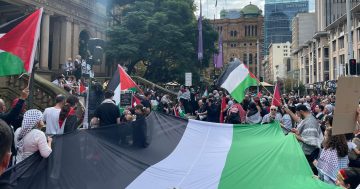

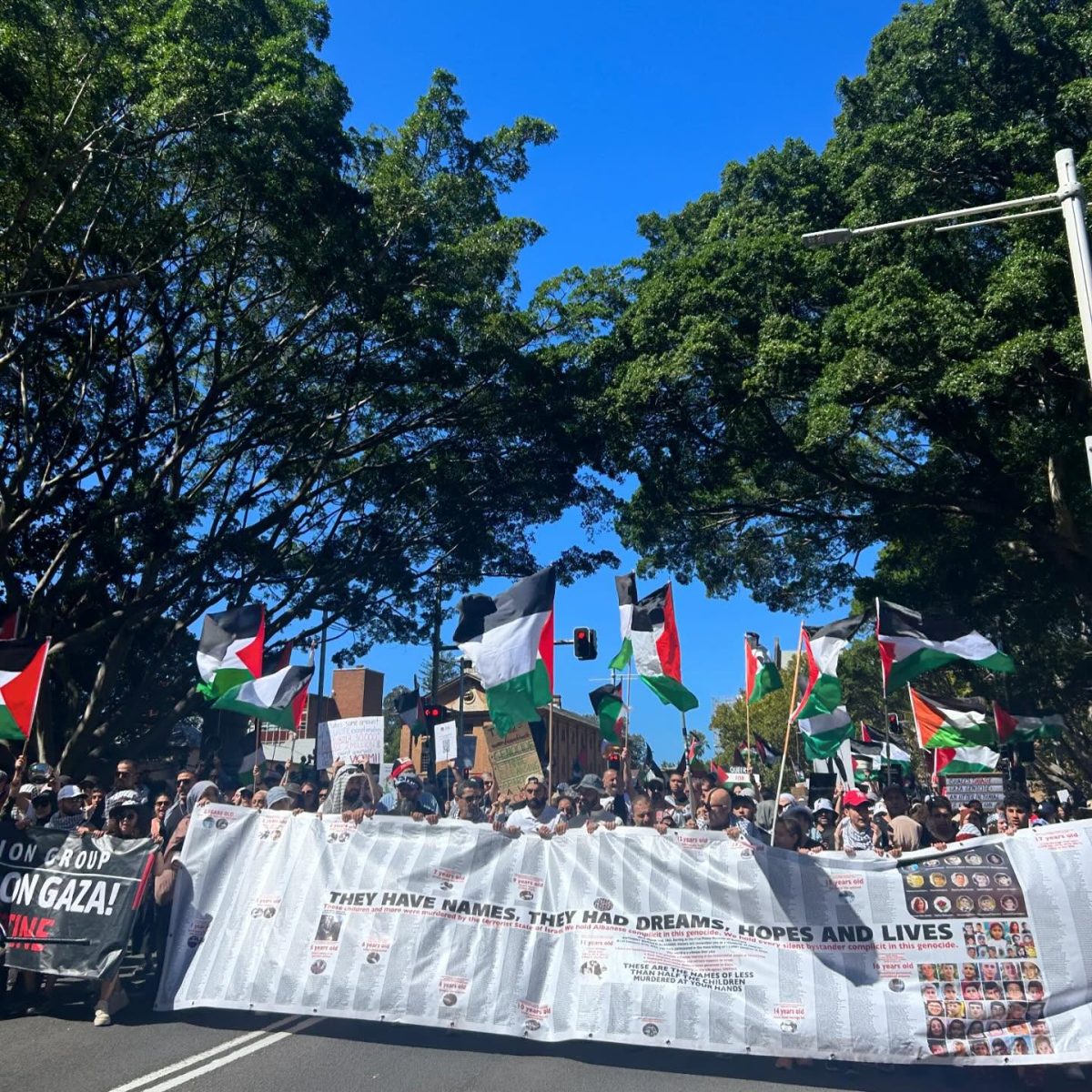
Pro-Palestine protesters could soon be banned from using certain slogans. Photo: David Shoebridge MP.
A NSW parliamentary inquiry on criminalising protest slogans such as “Globalise the intifada” has received 155 submissions, the vast majority of which opposed the concept of banning forms of speech.
The NSW Labor Government’s “measures to prohibit slogans that incite hatred” inquiry was launched on Christmas Eve but quickly closed its small window for public submissions by Monday 12 January. There were also no public hearings held, but a report on the inquiry findings will be submitted to parliament on Saturday (31 January). The NSW Government will then move to change laws on what it calls “hate speech”.
Albury-based Greens MP Amanda Cohn criticised the short timeframe for public consultation and the idea of more censorship.
“This NSW Government shouldn’t be jumping in to ban these slogans … there hasn’t been any link established between the types of phrases they’re talking about banning and what happened at Bondi,” she said.
Many academics, experts, legal agencies and community groups still managed to lodge their submissions, most of which expressed similar views to Dr Cohn.
“Slogans are often adopted by communities to represent or embody specific causes or political views which are, in and of themselves, neither dangerous nor grounded in hate. To criminalise them would disproportionately impact vulnerable groups,” Legal Aid NSW wrote in its submission.
Legal Aid NSW also noted that the timeframe to make a submission over the holiday period was such that most agencies “would have limited or no resources to respond”.
Ms Larissa Dulat, who said her submission was on behalf of “concerned migrant mothers living on stolen Aboriginal lands in Sydney” criticised what she called the narrow focus of the inquiry.
“It appears to centre primarily on slogans associated with Palestinian solidarity, such as ‘globalise the intifada’, or ‘from the river to the sea’ while other language that is racist, exclusionary, or intimidating … does not appear to be receiving the same level of scrutiny,” she wrote.
She questioned why slogans like ‘Israel should flatten Gaza’ were not being scrutinised.
Jewish groups were divided on the proposal.
The progressive Jewish Council said it was “deeply concerned that this proposed ban will lead to more polarisation and discrimination and, consequently, less safety for racialised communities, including the Jewish community … This will worsen social cohesion, increase racism and strengthen the narratives relied upon by the far right to grow.”
By contrast, political advocacy group Australia Israel & Jewish Affairs Council (AIJAC) supported banning not only the chant “Globalise the intifada”, but also “Death, death to the IDF [Israel Defence Force]”.
“Globalise the intifada” is a slogan used to advocate for international support of Palestinian resistance against Israeli occupation, though some see it as a call for political violence.
Former Riverina teacher Jim Kable called the inquiry a “farce” and urged it to resist the concept of banning slogans.
“I urge this body not to make any determination about any particular slogan – if the Premier can be as ignorant as he has shown himself – I cannot imagine that this body should be making any determination other than to close down this kind of witch hunt,” he wrote.
A full list of submissions can be found on the NSW Parliamentary Inquiry website.
Original Article published by Oliver Jacques on Region Riverina.