
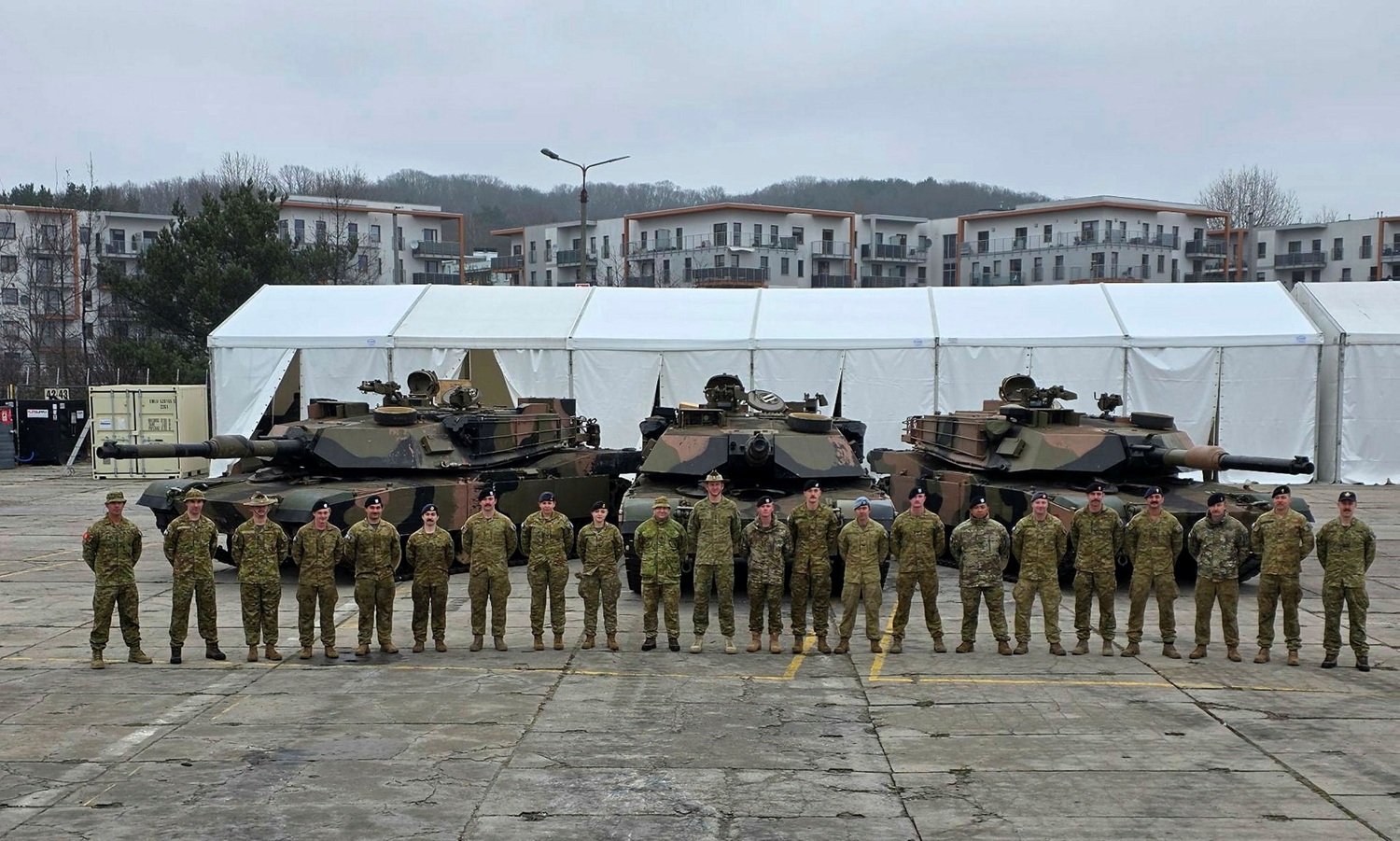
Former Australian Army M1A1 Abrams tanks and Australian support personnel in Poland. Photo: ADF.
Australian Abrams tanks reach Ukraine
The last of 49 former Australian Army M1A1 Abrams main battle tanks has been delivered to Ukraine, after they were replaced in Australian service by newer M1A2 models and were donated by the government.
The tanks were shipped to Ukraine via Poland in batches between July and December 2025, where they were refurbished and upgraded before being handed over to Ukraine to join the fight against Russia’s invasion.
Australian Army maintainers have remained in Poland to support the initial service entry of the tanks, and reports indicate the vehicles have already seen combat in Ukraine’s eastern Donbas region.
Taiwan approved for more US defence equipment
Taiwan has been approved to buy nearly US$11bn (A$16.4bn) worth of weapons and support equipment from the US.
To be acquired through the Taipei Economic and Cultural Representative Office in the United States (TECRO), the US State Department approved the sale of advanced communications systems for an estimated cost of US$1.01bn, Bell AH-1W helicopter spare and parts valued at US$96m, and M107A7 self-propelled howitzers for US$4.03bn.
Other equipment includes high mobility artillery rocket systems (HIMARS) and related equipment for US$4.05bn; tube-launched, optically tracked, wire-guided (TOW) anti-armour missile systems for US$353m; Javelin anti-armour missile system for US$375m; AGM-84 Harpoon anti-ship missile repair follow-on support for US$91.4m; and ALTIUS loitering munitions for US$1.1bn.
Babcock teams with HII on Virginia class
HII (formerly Huntington Ingalls) and Babcock International Group have announced a contract to expand their partnership to further support Virginia-class nuclear-powered submarine construction at HII’s Newport News Shipbuilding (NNS) division in Virginia.
As part of the deal, Virginia-class submarine assemblies will be built by Babcock at its Rosyth facility in Scotland, before being shipped to the US for final assembly.
This agreement raises the possibility of Australia’s ASC perhaps joining HII’s Virginia-class global supply chain as it expands and upskills its own workforce at Adelaide’s Osborne yard before construction of Australia’s SSN-AUKUS submarines commences in the late 2030s.
Chinese Q-ship
An interesting development came out of China in December, with a commercial vessel being spotted carrying at least 48 containerised missile launch cells on its deck.
The vessel – which resembles a commercial bulk or container carrier – also featured radars, defensive close-in weapons systems, drone and decoy launchers, and other military systems, leading to speculation that China is toying with the idea of putting disguised commercial ships with hidden combat capabilities – or ‘Q-ships’ – into service.
In World Wars I and II the German Navy operated a number of ‘Q-ships’ which, while resembling commercial freighters operating under a different flag, were actually heavily armed raiders which would take enemy naval and commercial shipping by surprise by opening fire at close range.
One such vessel, the German Kormoran, sunk the Australian light cruiser HMAS Sydney in a surprise attack off the coast of WA in November 1941, although it too was sunk by the Sydney’s guns.
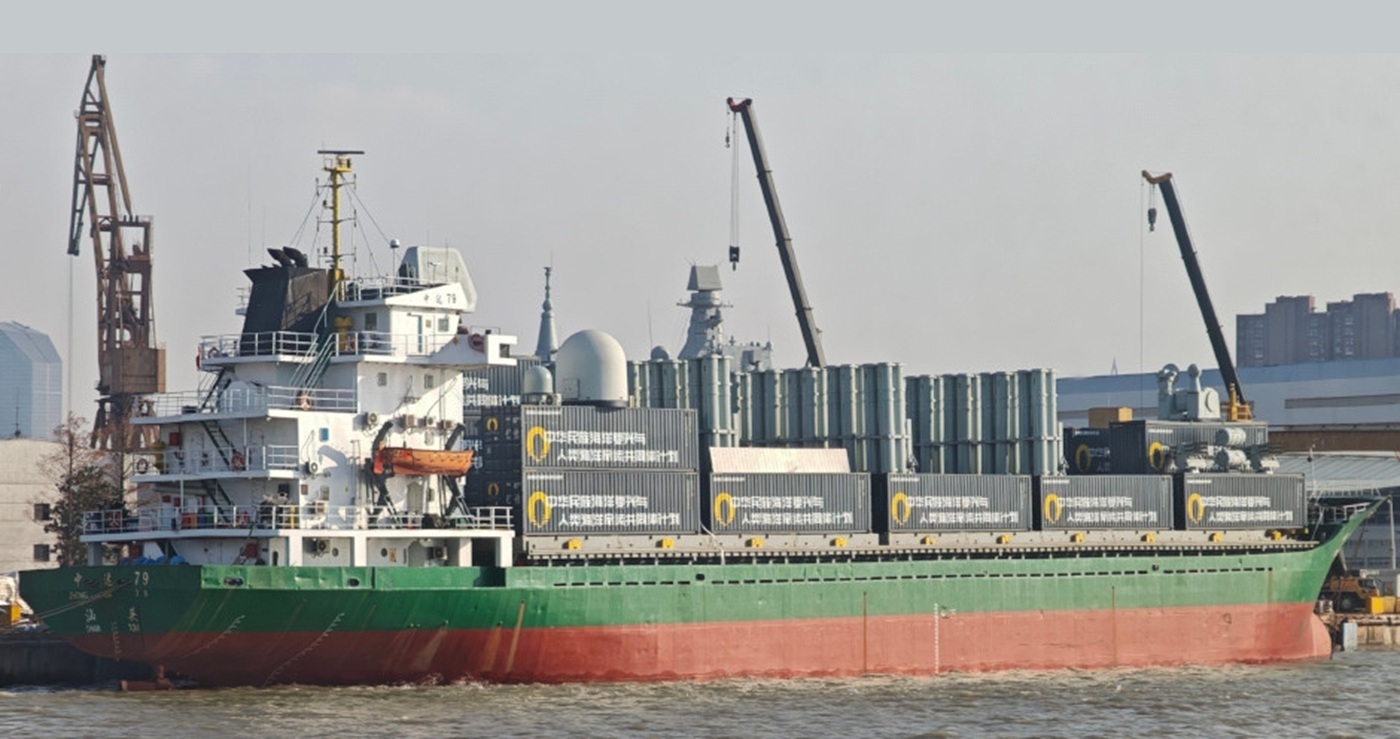
Photo: Chinese social media.
RAAF C-130J Hercules upgrade complete
The Royal Australian Air Force’s 12 Lockheed Martin C-130J-30 Hercules transports completed a Block 8.1.1 upgrade in late 2025.
The upgrade is designed to bring the RAAF’s aircraft up to the latest US and global navigations standard, and includes software and hardware enhancements including improved communications, enhanced navigation and civil datalink, and GPS.
The aircraft which have been in RAAF service since 1999, are scheduled to be replaced by 20 new C-130J-30s from 2027.
ADF Air Mission Training System provider selected
The government has announced that a team led by CAE Australia has been selected to provide the RAAF’s new Future Air Mission Training System (F-AMTS) to train crews.
The system will utilise new and upgraded training and simulation systems and facilities to train air battle managers, navigators, electronic warfare officers, and other non-pilot aircrews to operate the systems in aircraft such as the MQ-4C Triton, MC-55 Peregrine, E-7A Wedgetail, P-8A Poseidon, and other platforms that require sensor and communications operators.
The $300 million F-AMTS will be located at RAAF Base East Sale in Victoria’s Gippsland region.
US Air Force orders extra 747s to support new Air Force One
The US Air Force will acquire two former Lufthansa Boeing 747-8 airliners to support its program to replace the presidential Air Force One flight.
Currently operated by the USAF’s 89th Airlift Wing at Andrews AFB near Washington DC, two heavily-modified 747-200s entered service in 1991 to provide secure VIP transport for the US President. These aircraft are being replaced by two new 747-8s which are scheduled to enter service in 2028.
The two ex-Lufthansa jets will provide a source of spare parts and training, as the 747 is no longer in production and the global fleet of the upgraded 747-8 model is quite small.
Kongsberg cements partnership agreement
Kongsberg and the Commonwealth have signed a strategic partnering agreement designed to drive collaboration and engagement under Defence’s sovereign guided weapons and explosive ordnance (GWEO) enterprise.
The Kongsberg Program Agreement formalises the industrial and strategic cooperation between Kongsberg Defence Australia, Kongsberg Defence & Aerospace, and the Commonwealth, and provides a single programmatic approach for the management of a range of GWEO activities.